
Where does a wet umbrella go when your work bag already holds tomorrow’s laptop? On the days between winter commutes, your bag, coat, shoes and office equipment need different homes. Give damp outer items a place to dry according to their care instructions, then keep tomorrow’s dry work kit together near your usual packing spot. This keeps a wet umbrella out of the laptop bag and the dining table clear for working from home.
Walk your actual route from the front door to the desk before choosing any storage. Where do you put the bag down to take off your coat? Where does the laptop come out? Where do you look for your gloves the next morning? The best arrangement often follows that sequence across two small places.
Give wet arrivals a drying place and keep dry departure essentials together near your packing spot.
Working from home changes what the hallway has to do between journeys. I would start by watching one arrival in the rain before deciding where another hook or basket belongs.
For the space where the kit will dry or stay between days out, see my guide to the winter home office.
- Separate arrival from departure
- Make a small inventory by destination
- Use the doorway without taking over the hallway
- Keep the system useful when the weather changes
- Test the next departure
- Walk through the morning with one hand occupied
- Make room for an unexpected office day
- Final Word on Storing Winter Commuting Kit
Separate arrival from departure
An arrival place handles what comes in from outdoors. It might be an existing coat hook with a washable mat beneath it and a place for a wet umbrella that can be cleaned. Choose something suitable for the floor and the material being dried, where water and bulky objects stay clear of the walking route.
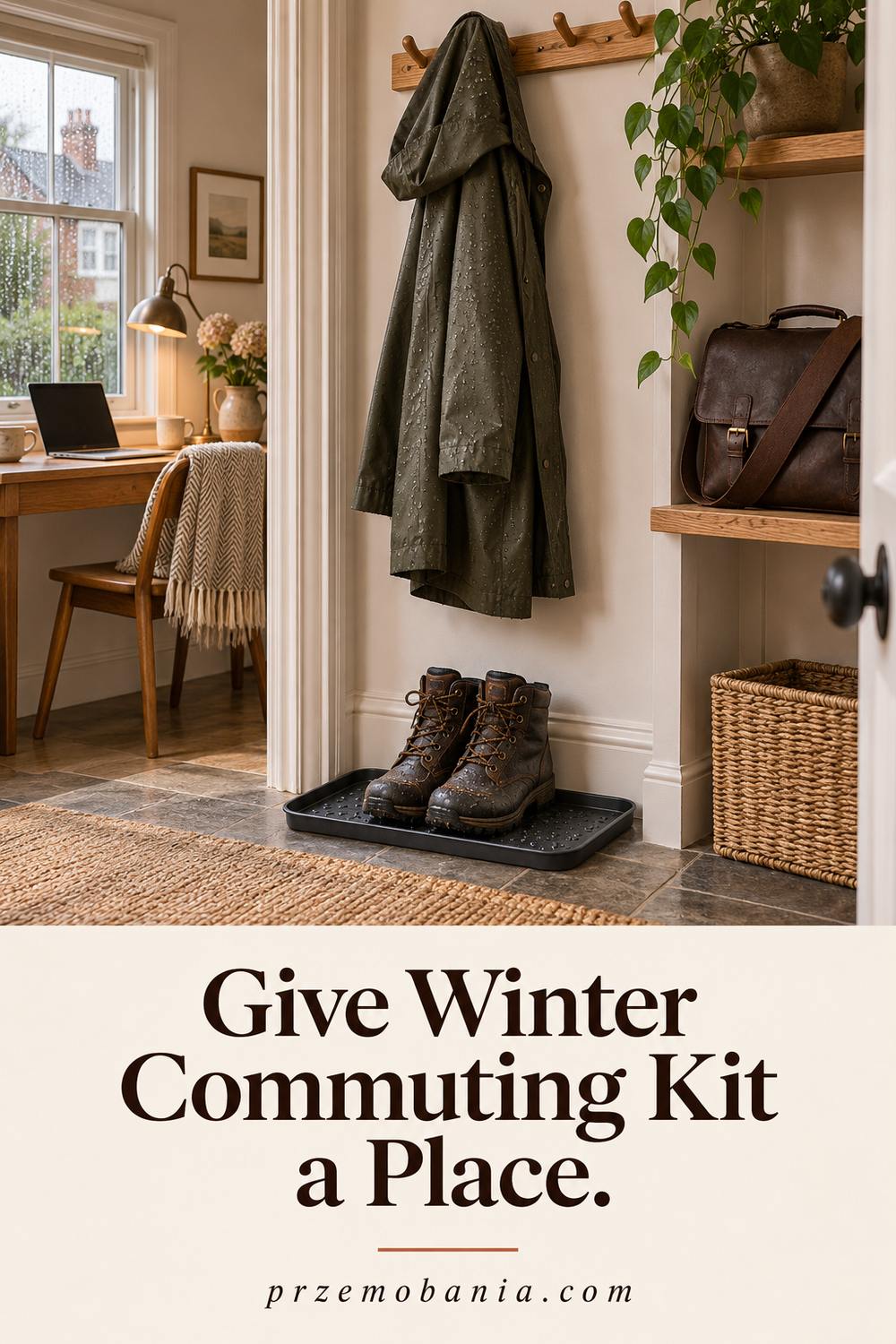
A departure place holds the dry things you need to take to work. In a small home, it can be one shelf, a tray inside a cupboard or a section of your desk storage. It should be somewhere you can reach on the way out without crossing the home to retrieve a pass, notebook and charger separately.
Trace one rainy Tuesday evening
Suppose you come home with a damp coat, wet umbrella, work backpack and a dry document folder inside the bag. Deal with the outer items at the entrance. Then take the backpack to its dry packing place and remove the laptop and documents for tomorrow’s home-working day.
If the bag itself is damp, follow its care guidance and keep it separate from papers and electronics until dry. Repacking the laptop into the same bag immediately can undo the benefit of keeping coats away from the desk. A spare clean surface for the equipment is more useful here than another hook.
Make a small inventory by destination
| Item | Between office days | Next departure cue |
|---|---|---|
| Coat, scarf and gloves | Dry according to their care labels, then bring the set together | Check pockets and pair gloves |
| Pass and keys | Usual secure household place | Collect when closing the bag |
| Work papers | Approved work storage, separated from damp items | Pack only what the trip requires |
| Laptop and charger | Home workstation while in use | Add after final home task |
| Umbrella and travel bag | Dry in a suitable place; store ready when dry | Check forecast and bag condition |
Follow your employer’s storage arrangements for equipment and documents. If a work pass normally lives in a secure spot, leave it there and put a written reminder in the packing place. You do not have to put every object in plain view to make the departure routine reliable.
Use the doorway without taking over the hallway
In a shared entrance, allow space for the other people who use it. Check the fully open door, the route past the shoes and access to the nearest cupboard. A neat row of bags can still be an obstacle if everyone has to turn sideways past it.
If the hallway has no spare wall, use the suitable drying provision you already have elsewhere in the home. Keep the transitional step short: deal with the wet item, then carry the dry office kit to its own place. Avoid building a permanent office bag station in a shared or communal escape route.
Adapt the routine to a pack-away desk
At a dining table, your laptop may move between an office bag, a home storage box and the work surface. Keep the home box in the same accessible place on office days so it is ready when you return. Its contents might be a mouse, notebook and headset that stay at home.
On the evening before travel, put the empty, dry bag beside the box. Pack everything you have finished using and leave a note for anything still connected. “Add laptop and work charger after final call” is easier to act on than trying to remember whether the bag that looks full is ready.
Keep the system useful when the weather changes
A wet week may fill your modest arrival area faster than expected. Empty dry items back to their usual places before adding today’s kit. If two people commute, label or allocate separate dry spaces for similar gloves, travel passes and black laptop bags.
In a rented room or shared flat, try the arrangement with existing furniture for a week before buying hooks, racks or baskets. A folded scarf in a drawer and a clear route to the coat cupboard can serve better than a new stand that narrows the door. For the rest of the room through the season, see the guide to a comfortable winter home office.
Split the routine when two people borrow the same space
If one person works at home on Monday and the other on Tuesday, keep one shared work surface and separate departure containers. A single notebook or pass left in the shared desk drawer can otherwise travel with the wrong person. Labels on the containers can be as simple as names written on two reusable paper tags.
Try the handover in both directions. At the end of Monday, the first person clears personal travel items and leaves any shared mouse or lamp in its normal place. The second person can then set up on Tuesday without moving somebody else’s damp bag or opening work documents. Give any item that must travel a clear owner for that day.
If only a tiny shelf is available, use two thin pouches and one landing place for the bag currently being packed. The important distinction is whose journey the contents belong to, not how much furniture you can fit near the door.
Test the next departure
On the evening before an office day, find the dry bag, identify what is still in use and check what needs collecting from the entrance. If an item repeatedly goes missing, adjust its home at the point where you take it off or unpack it.
When you can come in from the rain, sit down for a home-working day and leave again with the right dry kit, the arrangement is working. It should give your desk back to you between journeys.
Walk through the morning with one hand occupied
Imagine it is dark outside, the laptop is already in your work bag and you are holding a travel mug. Stand where you normally put your shoes on and try to locate the things you need for the first five minutes of the journey. If collecting gloves means opening the wardrobe behind your wet coat, the storage arrangement asks too much of a routine you perform in a hurry.
Use a clear surface for a brief packing rehearsal. Put everything for the next office day on it, then divide the pile by when each thing is needed. A pass used at the front gate needs a different place from a spare pair of socks that might stay packed all day. Put frequently reached items where you can find them without exposing a laptop or papers to the rain.
Now walk the route backwards from the door to the desk. Where would you naturally set down a damp umbrella while you reach for your keys? Where does the pass go once you take off the coat that held it? Place a suitable drying spot and a dry home for the pass close to those real decisions. A modest arrangement used every time beats a handsome box in the wrong room.
Make room for an unexpected office day
The awkward departure is often the one you did not expect. A colleague asks you to come in tomorrow, while half the kit is drying and your work bag is serving as a desk drawer. Keep one small written list based on a journey you really make. Include the things you cannot easily replace once you have left home and the checks that depend on the season.
For example, an evening reminder to check the forecast and the operator’s service information still leaves you time to alter the route or rearrange an appointment. Store the ordinary travel items together and add weather-dependent items after that check. Packing every winter item for every trip can make a small bag heavier while still leaving out the one thing the journey requires.
At the end of a week, look at anything that never left the launch point. An unused spare may have a genuine job, but a collection of duplicate scarves can hide the gloves you actually reach for. Keep the everyday selection near the door and store occasional extras with the rest of your clothing. Review the choice when your destination or commute changes.
Final Word on Storing Winter Commuting Kit
Give tomorrow’s departure a dry starting point and today’s wet kit a place to recover. Try one complete arrival and one departure before buying storage. The part of the route where you have to put everything down is the first part worth changing.
Which part of your morning departure could be easier? I’d love to hear in the comments. You can also read the free chapter of my cosy home office eBook.

Find Out More About Me

Przemo Bania is a blogger and writer who helps people get out of their traditional jobs to start a blogging career. Przemo also runs a health blog advocating for endometriosis and fibromyalgia…
Related Questions You May Be Asking About Storing Winter Commuting Kit
Where can I store wet kit if my front hall is tiny?
Choose a suitable drying place you can reach without carrying dripping items past your work equipment. Use the doorway only as long as needed to remove the wet layers. Bring things back to the dry departure point once they are ready to put away.
What if I travel by bicycle one week and train the next?
Keep the essentials common to both journeys together and give the extra items for each route a separate place. Select the route before packing. Check current conditions, service information and the condition of any travel equipment you rely on rather than assuming yesterday’s arrangement still works.
Can the work bag stay packed between office days?
Yes, for dry items you genuinely need on the next trip. Empty anything damp, remove food and follow your employer’s requirements for work devices and documents. Keep a brief reminder for items used at home in between, such as the charger that otherwise stays plugged in at the desk.
How should two people share a single hook or shelf?
Separate ownership at the point of choice. Two labelled pouches or distinct shelf positions can hold passes and gloves while coats share the broader space. Test it when the first person leaves early. They should be able to gather their own items without moving damp belongings onto the other person’s work bag.
Storing Winter Commuting Kit References
- Met Office guidance on travelling in storms, rain and wind
- Met Office guidance on travelling in snow and ice
