
Would you collect a second-hand desk if the seller handed you a sandwich bag of screws and said, “I think they’re all there”? A missing handle and a missing connector can look equally insignificant in the bag. They leave you with very different purchases when you get home.
Before agreeing to collect, identify the desk, match the missing fitting to the correct assembly drawing and confirm how you would obtain it. If any of those steps fails, price the desk as incomplete.
When I plan a home office around family life, an unusable desk taking up the room matters as much as an unexpected expense. My guide to the total cost of a second-hand desk helps you weigh those costs together. Here we’ll narrow the decision to one question: can you actually get the parts that this particular desk needs?
- Find out what the seller means by missing fittings
- Identify the exact desk before looking for spares
- Get a replacement answer you can use
- Put the uncertainty into the price
- Keep the verified set together at collection
- Final Word on Buying a Desk With Missing Fittings
- Related Questions You May Be Asking About Used Desk Fittings
- References
Find out what the seller means by missing fittings
Start with the seller’s own description. “One screw missing from the drawer handle” tells you where to look. “It all comes apart and the screws are in a bag somewhere” leaves open whether the desk can be assembled at all.
Ask which part was missing while the desk was in use, and which parts were removed during dismantling. These are two different lists. A desk that stood level last week may still be missing the fittings that joined its sections after they were separated for transport.
A useful message is short enough to answer on a phone: “Could you show me where the missing piece goes, the label underneath the desk and the loose parts that come with it?” Give the seller the option of saying they do not know. An honest unknown is more useful than a guess you later treat as a promise.

Separate an absent part from a damaged fixing point
Suppose a drawer pull has come off. Ask to see both the pull and the face of the drawer. A missing fastening with the surrounding material intact presents a different problem from a pull that has torn away a piece of the drawer front.
Apply the same distinction to a frame connector. A replacement connector supplies the missing metal piece; it does not restore a split panel, an enlarged hole or an insert pulled out of the board. If a photograph cannot settle which problem you are looking at, put the decision on hold until you can inspect it or obtain advice from the maker.
Identify the exact desk before looking for spares
Save the model name, article or product number, width and layout from the label or original paperwork. Note which side the drawer unit sits on and whether the top has one support frame or separate legs. Those details give you something to check against the drawings.
A name copied from a marketplace listing is a starting point. Sellers sometimes use the name of a similar range because the finish looks familiar. Compare the number and position of the legs, drawer arrangement and underside of the top with the maker’s pictures before treating a manual as a match.
If the label is gone, ask whether the seller still has an order email or instruction booklet. A cropped photograph showing just the product description and number is enough; you do not need their address or order details. Write down what is confirmed and leave the product number blank if it is still unknown.
Use the drawing in both directions
Open the instructions for the matching version and find the assembly step that shows the joint. Trace the illustrated fitting back to the parts list. Then work forwards again: where else in this desk does that same part appear, and how many should there be in total?
Consider a drawing that shows two identical connectors on each side of a drawer unit. The seller might have removed two and left the other two installed. Counting only the loose ones would turn a complete set into an apparent shortage, while counting every circular metal head as a match could conceal the opposite problem.
Make a note in ordinary language alongside any part number. “Two loose, two still in the left unit; please leave those installed” is more useful at handover than a row of unexplained numbers. A component pictured beside the desk may belong to another item the seller dismantled on the same afternoon.
Get a replacement answer you can use
Ask the maker or its parts service about the exact item in the drawing. Include the desk identification, the assembly step, the part code where available and the quantity you need. Save the response with the listing so you do not have to repeat the search on collection day.
For example, IKEA UK provides assembly instructions through its product support pages. Its small-spares guidance explains how to use codes from the instructions to request eligible parts. This is a useful route for an identified IKEA desk; it cannot establish whether an unmarked desk uses the same fitting.
Distinguish a catalogue entry from an available part. A picture proves that a fitting exists in the documentation. For your buying decision, find out whether you can order it, whether it comes individually or in a set, what delivery costs and when the desk could realistically be used.
When two pieces look much the same
A listing photograph may show two silver bolts with similar heads but say nothing about their threads or the components they engage. A seller’s ruler can help a supplier distinguish candidates, but a visual match alone cannot confirm compatibility. Ask for the maker’s specification or an explicitly confirmed equivalent before counting the problem as resolved.
This matters especially for the connections between the worktop, supports and frame. Avoid buying a mixed bag of hardware on the assumption that something inside will fit. If the maker cannot identify the part and the desk depends on it, a complete desk gives you a better comparison than the price of a handful of screws.
Put the uncertainty into the price
Compare two versions of the purchase on paper. In the first, the confirmed part arrives as promised. Add the asking price, collection cost, part cost and delivery charge; beside that total, write the first day you could set the desk up.
In the second, the part cannot be obtained. List what you could actually use, where the panels would have to wait and whether you would need another collection trip to replace the desk. If your spare room has to accommodate a guest next week, waiting has a consequence even when the missing fitting is free.
Here is an illustrative comparison. A £35 dismantled desk with £12 collection and an £8 delivered fittings pack comes to £55. A complete £55 desk within walking distance might still need transport, so compare both delivered totals before choosing. The incomplete option earns its place only if the pack really covers the missing items and the waiting time works for you.
Agree what happens if the count changes
Before travelling, agree which pieces will be ready to inspect. You might write, “I’m happy with the missing handle we discussed, provided the frame parts shown in the manual are all there.” That gives both people a clear understanding of the proposed purchase.
If the seller discovers another missing item, ask for its location in the drawing before setting off. Revisit the price and the collection plan together. A small change to the contents can make a booked van unnecessary, particularly if the missing piece is the one that connects the two halves.
Keep the verified set together at collection
Bring the saved drawing, your short count and a few small bags with paper labels. Start by matching the large pieces to the diagram. It is easier to recognise a missing runner while the drawer and both sides are in front of you than after everything has been stacked in the car.
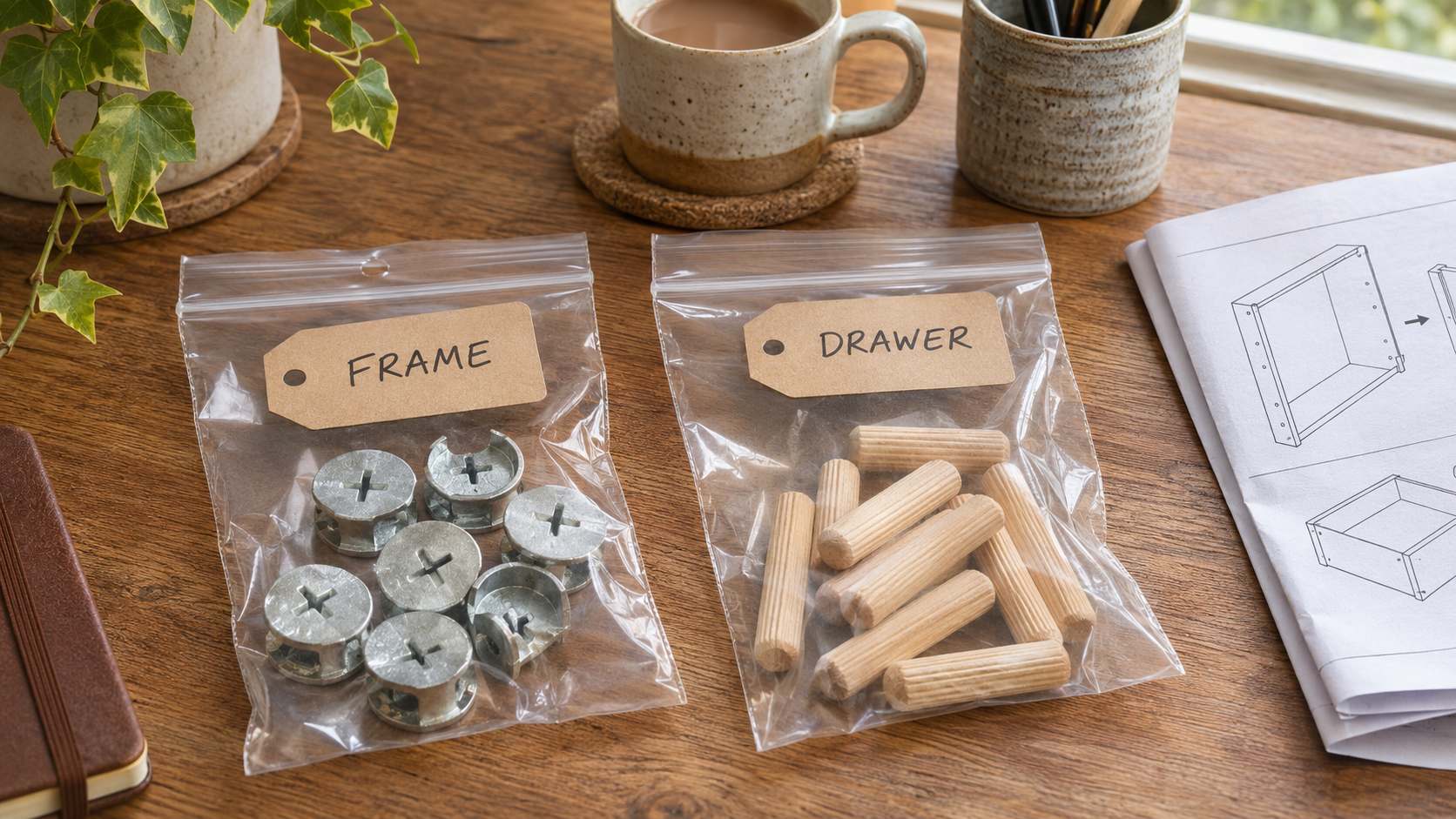
Keep the frame hardware together and give each different drawer assembly its own label. Write the location as well as the quantity on the bag: for example, “right drawer, parts removed from front”. Photograph the labelled bags beside their panels and pack them in a container you will open first at home.
Leave factory-installed pieces in place when the instructions allow them to travel that way. Ask before removing anything from somebody else’s furniture, and use the maker’s dismantling instructions where supplied. Your purpose at collection is to keep a known set together, not to take every fitting out just to count it.
Final Word on Buying a Desk With Missing Fittings
The most useful thing to take to collection is a short answer to three questions: what is missing, where does it belong and how will it be replaced? A part number, a confirmed supply route and a complete delivered price turn a vague worry into a decision you can make before leaving home.
There will also be listings where the answer stays uncertain. If you need a working desk on Monday, it is reasonable to leave that one with the seller. Save the details of the complete desk you compared it with so you can pick up your search without starting again.

Find Out More About Me

Przemo Bania is a blogger and writer who helps people get out of their traditional jobs to start a blogging career. Przemo also runs a health blog advocating for endometriosis and fibromyalgia…
Related Questions You May Be Asking About Used Desk Fittings
What if the seller says the missing piece is only decorative?
Ask them to indicate it on the drawing or show the point where it belongs. A removable trim cover and a connector hidden under that cover serve different purposes. Once you know which is missing, decide whether the appearance matters to you and whether the maker specifies the piece for use.
Should I order spare parts before I collect the desk?
First confirm the exact desk and the seller’s willingness to hold it. A parts order and a marketplace agreement are separate arrangements. If your decision depends on having the parts in hand, agree the timing before committing to transport or paying for a kit you might never use.
What if an old model has disappeared from the current catalogue?
Keep the identification from the label and any reference printed on the instructions. Ask the manufacturer whether it can identify archived instructions or support that model. A current model with the same width and colour can still use different connections, so treat a suggested replacement as unconfirmed until you have a specific match.
Can a second identical desk supply the missing parts?
It can make sense if you can confirm the versions match, identify the exact donor parts and account for transporting and storing both desks. Compare that combined cost and effort with buying one complete example. Two incomplete desks can otherwise leave you with the same missing fitting and twice as many panels.
References
