

A desk can fit the room and still get stuck before it reaches it. The measurement that matters on delivery day is the size of the largest rigid package passing through the tightest part of your route. A slim box may go straight through your front door and then have nowhere to turn on the landing.
Before ordering, get the dimensions of every package, sketch the route from the agreed delivery point to the room and test any doubtful turn. A tape measure, a pencil and a spare piece of cardboard will tell you more than the width of the desktop on its own.
Start with the box, including the ends
Find the packaging information for the exact desk size and finish. For example, IKEA UK explains where to find package details on its product pages. If the seller only lists assembled dimensions, ask for the packed length, width, depth, weight and number of cartons.
List the boxes separately. A desktop can arrive as one long, shallow package while a drawer unit arrives in a shorter, thicker box. The first may be difficult at a turn and the second may be the problem at a narrow opening. Keep the carton numbers against the dimensions so you can identify which one needs special attention.
If the desk is already assembled
Ask which parts the seller can remove and what will actually be handed over. A description such as “legs come off” does not tell you whether the drawer pedestal stays attached. Ask for measurements of the largest rigid piece in its agreed collection condition, including fixed brackets or projecting handles.
Measure the route with the doors open
Start where the carrier will leave the delivery. An entrance hall, a flat door and a room-of-choice service present different routes. Confirm what your particular service includes before counting on someone else to carry the boxes upstairs.
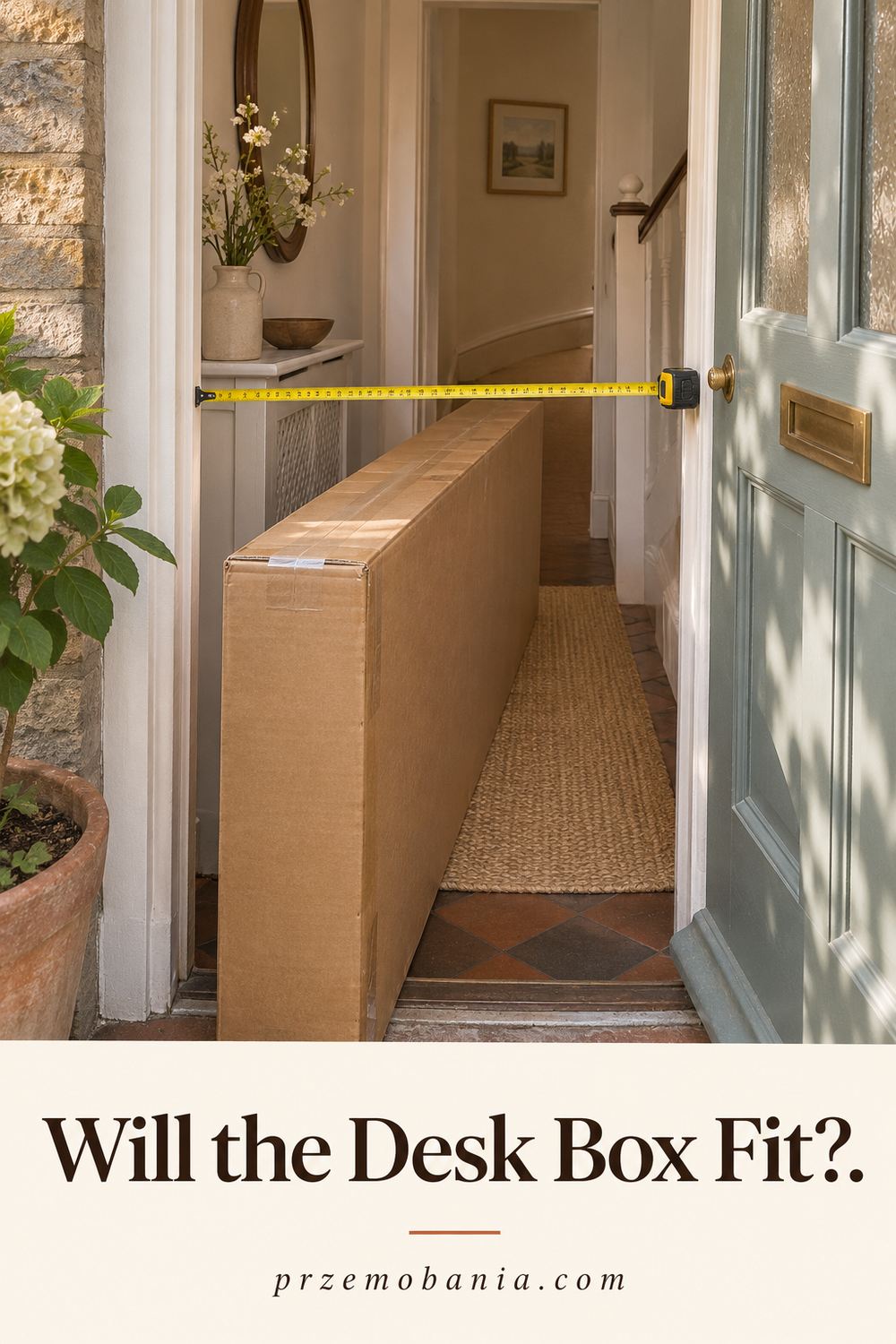
Measure the clear opening between the open door and the opposite frame. The measurement across the closed door leaf is a poor substitute. Look at the height of handles, the position of a door closer and the space the door takes up when it cannot open to a right angle.
| Place to check | What to record |
|---|---|
| Entrance or internal door | Clear width and height at the narrowest point with the door open |
| Hallway turn | Approach width, landing depth and clear space beyond the turn |
| Lift | Door opening, usable cabin depth and space to line up outside |
| Final room | Space to put down the carton and open it without blocking the door |
Measure in the same units throughout. If the seller gives sizes in millimetres and your sketch is in centimetres, convert them once and write the unit beside each number. A carton listed as 1,580 mm long is 158 cm long.
Work through a right-angle turn
Imagine a desk packed in a carton 158 cm long, 73 cm wide and 10 cm deep. A clear doorway 76 cm wide suggests the 73 cm face could pass straight through. It tells you nothing about whether you can align that face with the door when the opposite wall is close behind you.
Sketch the hall and the doorway at the same scale. At one centimetre on paper to ten in the hall, the 158 cm length becomes 15.8 cm. Cut a matching rectangle for the face you expect to carry through the turn. Slide and rotate it continuously from the hall into the room. Lifting it off the sketch and replacing it inside misses the difficult part.
Test the missing dimension
A paper sketch shows a horizontal slice. If the proposed solution means tipping the box up, check the ceiling, pendant lights, stair soffit and door head along the entire movement. A tall carton may fit when upright yet need more height while tipping. The space for a person’s hands and body matters too.
Use a light, full-size cardboard outline or ask the retailer to assess the measurements when the clearance looks marginal. A floppy outline bending around the corner gives a misleading result. On a communal stair, take measurements when the route is quiet and keep the route available to others.
Settle doubtful points before delivery day
If one turn still looks uncertain, send the seller a simple marked sketch and the package number. Ask whether they offer a smaller pack configuration, a different delivery service or another desk with a shorter rigid top. If unpacking at the entrance is suggested, agree who is permitted to do it, who carries the bare top and how it will be protected.
Do not count on a delivery team taking doors off or carrying outside the stated service. IKEA UK’s delivery access guidance is one example of why access needs checking before the vehicle arrives. Your order confirmation and carrier determine the arrangement for your delivery.
Check the decision with a three-line delivery note
Write down the largest rigid carton, the limiting point and what makes the delivery acceptable. For example: “Carton 2, 158 by 73 by 10 cm. Lift door has sufficient opening, but box cannot turn from the lift into our corridor in the proposed orientation. Seller checking whether an alternative package is available.” Someone reading that note can tell exactly what still needs resolving.
If two people measured different parts of the route, compare the sketches together before ordering. One person might have measured to the door frame while the other measured the clear gap with the door open. Resolving that difference from home is simpler than discovering it with the carton on a communal landing.
Leave room to receive and assemble the desk
Mark a landing spot indoors where the longest box can lie while the other packages come in. Check that placing the first box there still lets the door swing and allows someone to pass. If there is only one clear strip of floor in a small office, putting every box directly into it can make assembly harder than receiving the delivery.
Put your sketch, package numbers and agreed delivery point together with your home office setup checklist for beginners. Once you can trace each rigid package through every turn and name a place to open it, you have checked the journey that the desk will actually make.
Compare two delivery options before you pay
Imagine the same desk is sold in two versions. The first arrives with a single worktop in a long carton, while the second has a top supplied in two shorter pieces. Once assembled, they occupy almost the same space. At a narrow landing halfway up the stairs, those purchases can be quite different propositions.
Draw a line for each carton on a sheet of paper. Across the top, write the places where its orientation must change, such as the turn from the street into the lobby, the lift exit and the final bedroom door. Put a question mark wherever you have only checked the width. A straight run tells you little about the space available to complete the next turn.
Suppose the longest carton is 168 cm long and the lift interior measures 150 cm from front to back. That comparison rules out one level orientation. It does not establish whether the carton can enter the door diagonally, whether the doors can close, or whether the delivery team can handle it in the available space. Send the exact measurements and a photograph of the approach to the supplier before booking.
If the shorter cartons solve that access problem, look at the assembled design again. Where will the join sit in relation to your keyboard or drawing surface? Will you need unobstructed floor space to connect the pieces? You can then weigh a genuine assembly compromise against the cost or uncertainty of the first delivery option.
Check who is responsible for the last few metres
Read the wording of the delivery service against the route you drew. A front door can mean the building entrance in one arrangement and the entrance to your flat in another. If the description leaves the handover point unclear, give the retailer your floor number, lift availability and the location of any shared doors, and ask where the cartons will be left.
Think about what happens immediately after that handover. A long carton standing in a communal hallway leaves you with a problem even if it fits the front door. Arrange an agreed place inside your own space where the parcel can lie as directed while you check the labels and make room for assembly.
Final Word on Measuring for a Flat-Pack Desk Delivery
The decision to order should rest on the longest or most awkward package and the tightest change of direction. Keep the supplier’s package dimensions, the agreed delivery point and the measurement you want the delivery team to see in one place. If one turn still depends on guesswork, resolving it before checkout is much easier than solving it with the carton at your door.
Find Out More About Me


Przemo Bania is a blogger and writer who helps people get out of their traditional jobs to start a blogging career. Przemo also runs a health blog advocating for endometriosis and fibromyalgia…
Related Questions You May Be Asking About Measuring for a Flat-Pack Desk Delivery
Can I rely on the diagonal measurement of my doorway?
A diagonal is one piece of information about a flat opening. The carton also has thickness, and the space on each side determines whether it can reach and leave that angle. Check a three-dimensional mock-up or give the measurements to the supplier when the turn is tight.
What if the first box fits but the desk comes in several packages?
Check the package list by number before you arrange the delivery. A shallow worktop carton can be the longest while a shorter pedestal carton is deeper and harder to turn. Record the critical measurement separately for each package and tick it off only after checking the full route.
Could the box be opened downstairs and carried up in pieces?
Ask the retailer what its delivery team can do and how opening the pack affects handling and the inspection of damage. Some panels will still be the full length of the carton. Consider exposed edges, loose fittings and somewhere suitable to unpack before relying on this option.
What should I send the retailer if the landing is hard to describe?
Send a simple overhead sketch, the clear width at the turn and a photograph taken from the approach. Label which door opens into the landing and where its handle projects. Include the product and carton numbers so the response can apply to the exact order.
References
