
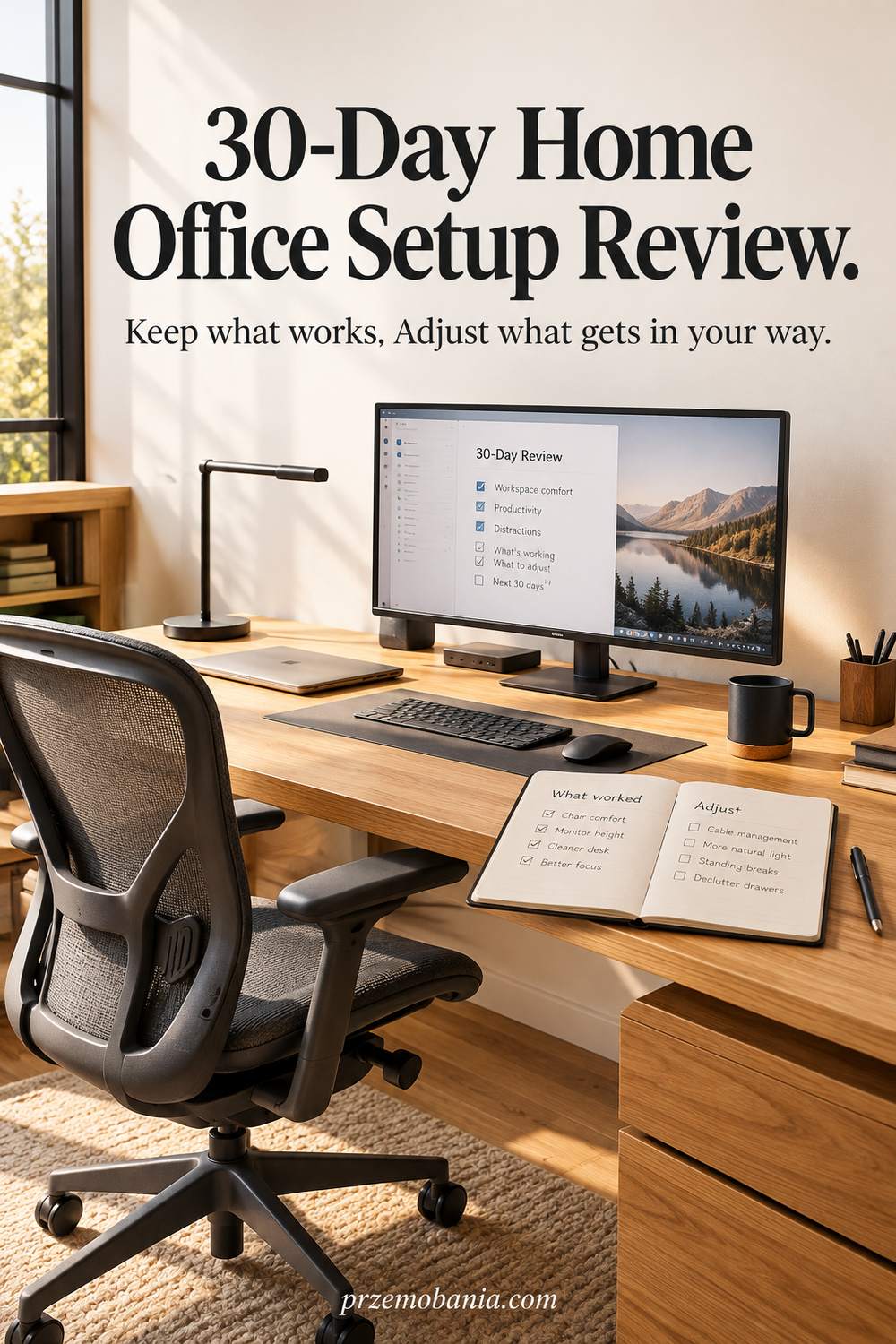
30-Day Home Office Setup Review
What has your workspace taught you during its first month that you could not see on setup day? A 30-day home office setup review helps you turn those everyday observations into a small, useful adjustment plan. If the room is mostly working but a few frustrations keep returning, you do not need to start the whole project again.
Review your first month by comparing a setup with real use: note repeated interruptions, awkward reaches, unused purchases and tasks that still feel difficult. Keep what works, prioritise unresolved problems, test one manageable change at a time, and set a follow-up date to check whether it helped.
My mum’s influence made me love a welcoming room, while supporting my wife after chronic illness changed our lives taught me to keep listening to the person using it; that experience, my blogging and the references below shape this review.
Thirty days is a convenient personal checkpoint, not an official safety interval or a reason to delay dealing with a problem. New discomfort, faults or significant changes need attention when they arise. This review looks back at the first month of a new setup, rather than assessing every possible feature of an established office. Keep your original home office setup checklist for beginners beside it so you can compare intentions with actual use.
Start Your 30-Day Home Office Setup Review with Observations
Begin with what happened during ordinary work, not with a new shopping list. Look at any notes you kept during the first month. Include the things that worked well as well as the problems.
If you have no notes, observe a few representative sessions before drawing firm conclusions. Choose tasks that reflect your normal workload. Avoid judging the whole setup from an unusually busy or quiet day.
Write down the moment when an interruption happens. Describe the task, the obstacle and what you did next. Keep private work information out of the record.
Separate equipment faults from preferences about appearance. Separate an occasional inconvenience from a problem that repeatedly prevents necessary work. Neither distinction means you should ignore discomfort or safety concerns.
Group similar observations so the same issue does not appear as five unrelated tasks. Choose the problems that deserve a clear response now. Leave optional improvements on a separate list.
Helping my wife use a workspace through changing needs taught me that yesterday’s good arrangement can still need adjustment today. My own blogging reinforces the value of noticing what the room actually asks me to do, rather than defending the choices I made when I first arranged it.
- Compare Your Plan with Actual Use
- Record Recurring Friction without Guessing
- Keep the Features That Earn Their Place
- Choose One Clear Change to Test
- Set a Follow-Up and Escalate Concerns
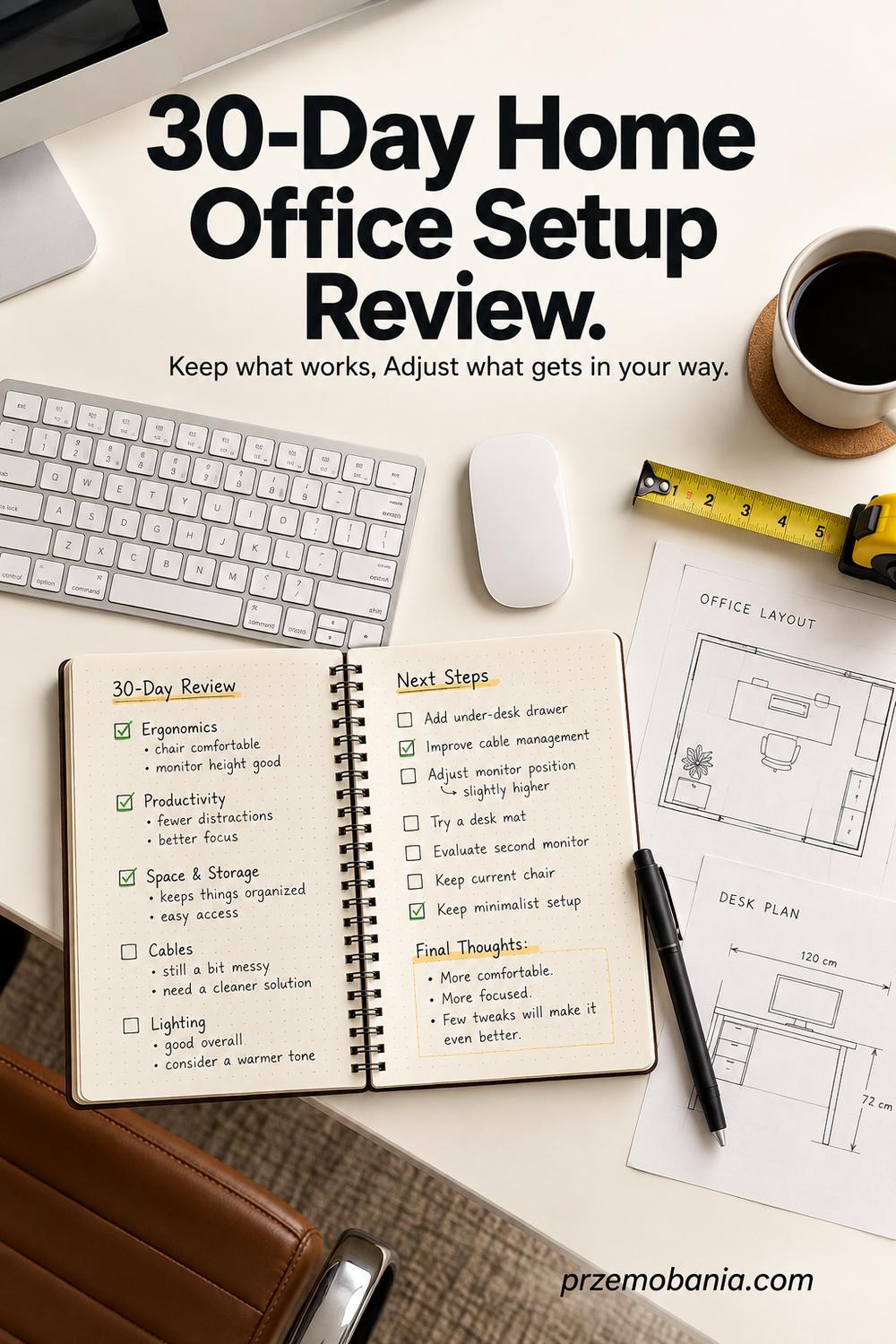
Compare Your Plan with Actual Use
Place the original checklist beside a short description of your typical working session. Look for tasks you expected to do often but rarely perform, and tasks that occupy more of the day than you anticipated. This comparison can explain why a carefully planned surface now feels crowded or a storage area remains untouched.
Note which assumptions changed rather than treating them as mistakes. You may use more paper than expected, join calls at different times or need to clear the desk for another household purpose. The useful question is what the room must support now, given the evidence of the first month.
Finish this step with a brief list of changed requirements. Keep it separate from the solutions so you do not jump immediately to a purchase. I would rather recognise that a daily task needs more accessible space before deciding whether the answer is moving an object, changing a routine or choosing different furniture.
Record Recurring Friction without Guessing
Describe the observable problem as clearly as you can. Write that you move the keyboard every time you use a notebook, rather than saying the desk is bad. Note that calls fail from a particular position, rather than assuming the whole internet service needs replacing before you have investigated.
Include when the issue appears and which task it interrupts. A reflection that arrives only in the afternoon needs a different investigation from a display problem present all day. You do not need a complicated diary, just enough context to avoid solving the wrong problem.
Keep discomfort and possible safety concerns on a prompt action path rather than waiting to collect a month of examples. HSE identifies new workstations, changes and reported pain or discomfort as reasons for assessment. This personal review helps organise your observations; it does not replace an employer’s process or individual advice where that is needed.
Keep the Features That Earn Their Place
Review the parts of the setup that make work straightforward. Perhaps your daily supplies are easy to find, the lighting is simple to adjust or a clear surface helps you begin without reorganising. Record those successes so a later improvement does not accidentally remove something that already serves you well.
Look at unused purchases without feeling obliged to justify them. An item can be attractive and still unnecessary for your present tasks. Decide whether it belongs elsewhere, should be stored appropriately or needs a return enquiry within the supplier’s actual terms; do not assume a 30-day return period exists.
Your output is a keep list alongside the action list. I find this useful because reviewing a room should not automatically become criticising every decision in it. A modest adjustment works best when it protects the useful parts of the arrangement and changes only what the evidence gives you a reason to reconsider.
Choose One Clear Change to Test
Select a manageable issue and define what improvement would look like before changing anything. If moving a notebook stand is the proposed solution, the result might be completing a writing task without shifting the keyboard. A specific result is easier to judge than hoping the whole room will feel more productive.
Where it is appropriate, change one relevant variable at a time and use the arrangement across representative tasks. This is a practical comparison, not a scientific experiment or a requirement to tolerate a poor setup. Stop a trial that introduces discomfort, instability or another problem rather than waiting for an arbitrary end date.
Record what changed and what happened afterwards. If the result is unclear, reconsider the cause before adding more products. Some issues need professional assessment or technical support rather than repeated home experiments, and recognising that limit can save time while getting the problem to the right person.
Set a Follow-Up and Escalate Concerns
Give each action a next step, an owner and a date to revisit it. The owner may be you, your employer’s support team or a supplier, depending on the issue. Use the date to check progress, not as permission to leave an immediate concern unresolved until then.
When seeking help, share a clear description of the problem and the steps already tried. Include only the information needed, keeping confidential documents and account details out of photographs or notes. A concise account can make it easier for someone else to identify what needs attention.
Close the review by deciding what can remain as it is and what still needs follow-up. You do not need to schedule a full redesign every month. Revisit relevant checks when your work, equipment or needs change, and keep the first-month record as a useful reference for the choices you made and the reasons behind them.
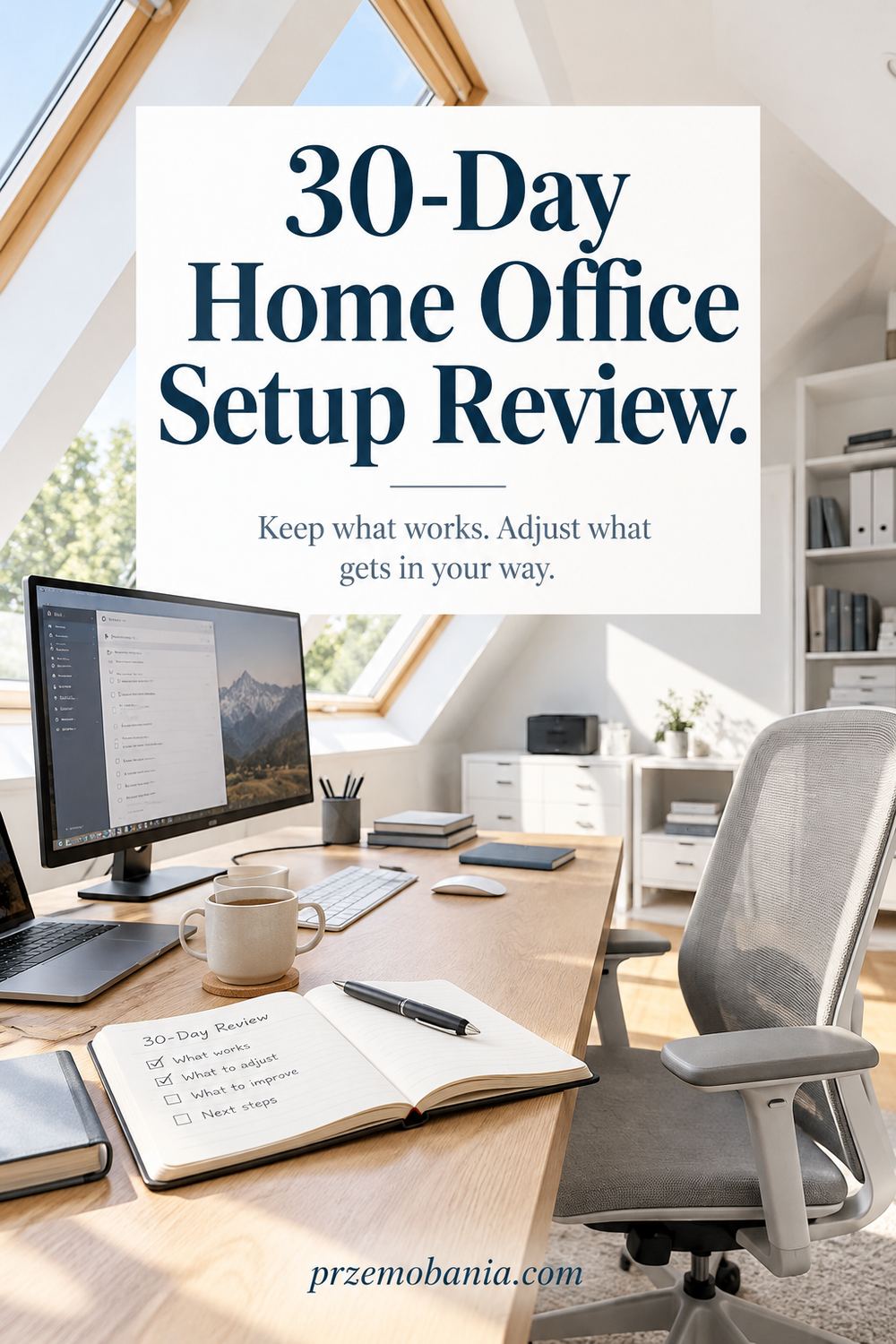
Turn Your 30-Day Home Office Setup Review into an Action Plan
Keep the action plan short enough that you can use it during an ordinary week. Put immediate faults and concerns on the appropriate response path first. Then identify the recurring obstacles that interfere with necessary tasks.
Write one concrete next action for each selected issue. Use actions such as contacting support, changing an accessible position or checking a measurement. Avoid a vague instruction to improve the office.
Add a way to recognise whether the action helped. That might be a task completed without moving equipment or a connection that works reliably during the required activity. Do not invent a productivity score if you have no useful way to measure it.
Record any cost before approving a purchase. Check whether the existing equipment can be adjusted or whether an employer or supplier should address the issue. Keep decorative preferences outside the list of necessary fixes.
Protect the successful features you identified earlier. If a proposed change would remove one, consider whether the trade-off is worthwhile. A larger desk may create more surface while reducing movement space, for example.
Finish by selecting a realistic follow-up date for the chosen actions. The review is complete when it produces clear decisions, even if some actions depend on help from somebody else.
| Observation | Next Action | Evidence to Check Later |
|---|---|---|
| Notebook use displaces the keyboard | Reconsider the reach and surface arrangement | Both tasks fit without repeated moving |
| Glare appears at a consistent time | Test an appropriate blind or light adjustment | The work remains clearly visible |
| A device repeatedly disconnects | Record the fault and contact support | The required task works reliably |
| Supplies collect on the surface | Give frequently used items an easier home | The reset takes fewer unnecessary steps |
| A purchase remains unused | Review its purpose and actual return terms | A deliberate keep, move or return decision |
| Discomfort persists | Seek the appropriate assessment or advice promptly | The concern reaches someone able to address it |
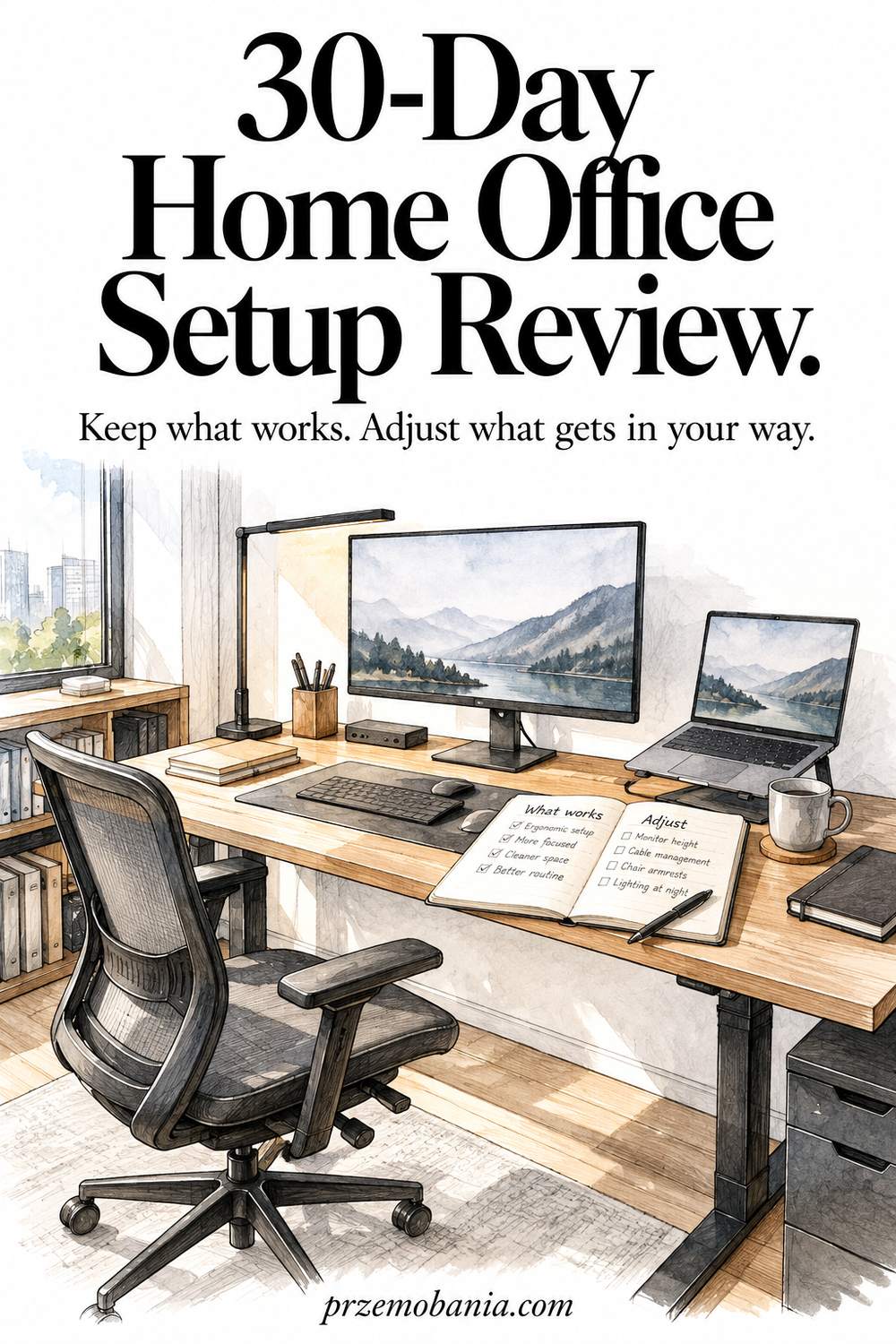
Know When a Review Should Lead to Further Help
A first-month review can organise evidence, but it cannot diagnose the cause of pain or certify a workstation as safe. Raise persistent discomfort through the appropriate route. If you are employed, use your organisation’s assessment and support process.
Treat damaged electrical equipment or unstable furniture as a current problem. Do not continue using something unsuitable to finish a comparison period. Get the relevant qualified or supplier support where the issue requires it.
The same principle applies to technical access. Repeated sign-in failures do not justify bypassing your organisation’s security arrangements. Describe the fault and ask for an approved solution.
Keep your review focused on what you can observe and reasonably change. Knowing when to pass a problem on is part of making the workspace more dependable.

Final Word on Your 30-Day Home Office Setup Review
The first month gives you something that planning cannot: experience of the room during real work. You know where objects gather, which tasks need more space and what interrupts you repeatedly. That information deserves a place in the next decision. You do not need to defend the original arrangement simply because you spent time or money creating it.
At the same time, a review should make successful choices more visible. If a simple storage arrangement works, keep it. If you can adjust the light easily and begin without clearing the desk, recognise that progress. A room does not have to develop a new problem every month to justify your attention, and an improvement does not always require another purchase.
I like the balance between noticing and accepting. Notice the things that create unnecessary effort, and accept that a lived-in workspace will change with your work. The goal is not to make the room immune to change. It is to make change understandable, so you can respond without feeling that the entire setup has failed.
My wife’s experience is a constant reminder that needs are not fixed. Something helpful can become less useful when circumstances shift. That does not erase the value it had before. It simply means the next decision should reflect the present situation, with the right support for questions that go beyond rearranging objects or choosing a different place for a notebook.
For your own review, finish with a small number of clear actions. A long wish list can make a mostly useful room feel hopelessly unfinished. One well-chosen adjustment, properly checked, can be easier to learn from than replacing several things at once. Where the issue is a fault or a health concern, direct it to the appropriate person promptly rather than turning it into a decorating project.
Keep the record somewhere you can return to when equipment or routines change. It will remind you why a particular arrangement worked and what you have already tried. That can prevent repeating an unsuccessful idea simply because enough time has passed to forget the reason you changed it.
Then allow the room to be used. A review is a pause for attention, not a permanent state of inspection. Once the necessary actions are underway, you can return to the work and life the space is there to support. The most valuable outcome is a little more understanding of your own needs and a practical way to keep the office responsive to them.
Your first month is useful evidence, not a verdict on whether you chose perfectly. Keep the parts that help, describe the problems clearly and choose a manageable next action. A thoughtful review lets your office develop around real use while protecting your time, your budget and the everyday routines that already work.
Share one thing your first month taught you about your workspace, and explore the FREE chapter of my eBook for more ideas about a home office that fits real life.
Find Out More About Me


Przemo Bania is a blogger and writer who helps people get out of their traditional jobs to start a blogging career. Przemo also runs a health blog advocating for endometriosis and fibromyalgia…
Related Questions You May Be Asking About a 30-Day Home Office Setup Review
1. Must I Wait Thirty Days before Changing Anything?
No. Address faults, discomfort and unsuitable arrangements when they arise. Thirty days is simply a convenient point to look back at patterns from ordinary use. It is not a prescribed safety interval, a diagnostic method or a reason to keep using something that is causing concern while you wait for a review date.
2. What if I Did Not Keep Notes during the Month?
Observe a few representative working sessions and record specific interruptions as they happen. You can also compare the original plan with the tasks you now perform most often. Avoid reconstructing precise numbers from memory. A small set of honest observations is more useful than a detailed record that only looks accurate.
3. Should I Replace Anything I Have Not Used?
Not automatically. Some equipment serves an occasional but necessary task. Check why you bought it, whether that need still exists and whether it belongs near the desk. If you consider returning an item, check the supplier’s actual terms and deadlines. The review date does not create a standard return entitlement.
30-Day Home Office Setup Review References
- HSE: Workstations and Assessment
- HSE: DSE Workstation Checklist
- HSE: Working with Display Screen Equipment at Home
- HSE: Work Routine and Breaks
