

Could you return a borrowed review sample tomorrow if the lender asked? A return shelf gives a borrowed review product one place to live between delivery, photography and collection. Set aside a shelf or box, give each loan a short identifier and keep its return date visible. The item, its accessories and its packaging can occupy different places, provided your record tells you exactly where each belongs.
Start with a single loan. You need a pencil, a card or digital note and a container for small parts. The size of your system should follow the number of products you actually have on loan.
Give each loan a home, a return date and a record that connects the product with its accessories and box.
As a blogger, I understand how easily one product can spread across a desk, a camera setup and a cupboard. I would organise the shelf around the day everything has to come back together.
- Record the agreement before opening the box
- Set up three places that work together
- Follow one loan through a real working week
- Pack against the arrival record
- Clear the space when the loan ends
- Give each booking a physical capacity check
- Prepare for a collection that fails
- Final Word on a Return Shelf for Review Samples
Record the agreement before opening the box
Check whether the product is a loan, a gift or yours to keep after the review. If the instructions are unclear, ask the sender. A photograph of the box cannot tell you whether a return is expected, who arranges the label or what condition the sender expects on return.
Write down the agreed return or collection date, who arranges transport and the contact you would use if the date changed. If you have a publication deadline as well, give it a separate line. Finishing the article and returning the product are two different jobs.
Give the loan a short name
Use an identifier you can repeat on the shelf card, accessories pouch and packaging. “Lamp A, November” is easier to read at arm’s length than a long order number. Record the full reference privately in the main note, where you can find it when arranging collection.
Photograph the contents as you unpack. Include the small parts on a plain surface so you can count them later. If a scuff is present on arrival, document it and follow the sender’s instructions for reporting it before ordinary use makes its origin uncertain.
Set up three places that work together
| Place | What goes there | What the label should say |
|---|---|---|
| Working shelf | Product while it is waiting for testing or photography | Loan name and next job |
| Parts container | Loose feet, cables, adapters or unused accessories | Loan name and an item count |
| Packaging location | Original carton, shaped inserts and protective sleeves | Loan name and location of the product |
For a small item, all three places might be inside one box. For a desk lamp, the carton may need to live on top of a cupboard while the lamp is on the desk. Put “carton above hall cupboard” on the shelf card so it can be found without a search when the courier date changes.
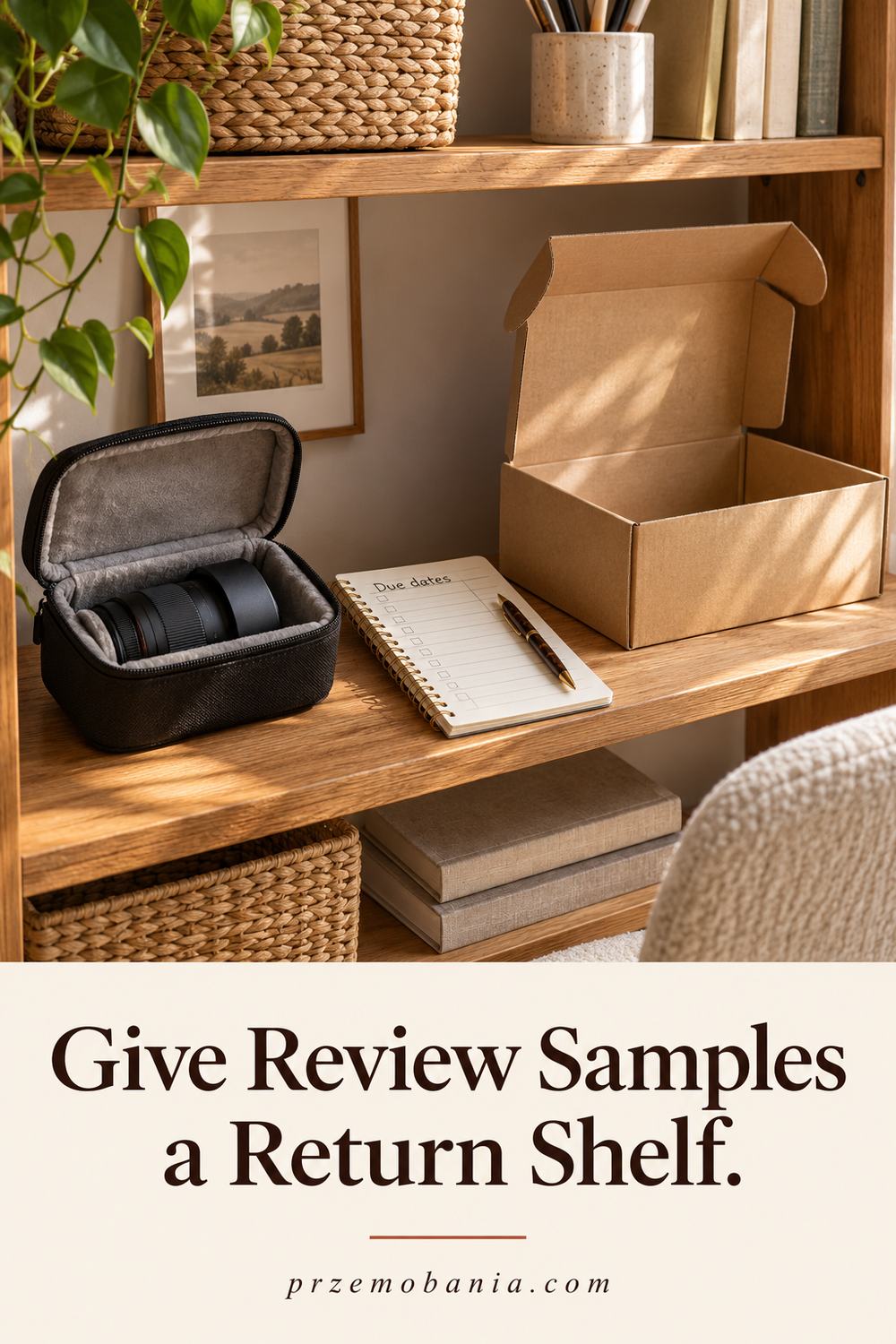
Fit the shelf into the wider guide to home office storage for bloggers. Keep borrowed items distinct from your own props. A guest clearing the desk should be able to tell that a loose adapter belongs with a loan even if they know nothing about the product.
Follow one loan through a real working week
Imagine receiving a lamp with a base, removable arm, power unit and two clips. Your unpacking photograph shows both clips. You attach one for the photographs and put the other in the labelled pouch. The shelf card says “one clip on lamp, one in pouch”. Counting what is visible in the pouch alone would make it look as though something were missing.
After the shoot, you move the lamp to a side table to finish your notes. Leave the card on the return shelf and update the product location. That ordinary act matters more than keeping the shelf photogenic. An empty space without a note gives no clue whether something is being used, has been returned or has gone missing.
Keep borrowed accessories out of the general drawer
Leave the loan’s cables and adapters with the product or in its labelled pouch. A familiar-looking lead from another kit is easy to pack by mistake. If an accessory must move to a second location for a photograph, move its label or update the record as part of that job.
If you receive two versions of the same product, give them different identifiers at the start. Colour alone can be a poor identifier when the cartons and all the small parts look alike. Keep a photograph of the particular item beside its own list.
Pack against the arrival record
Put the product and every accessory on a clear surface. Compare them with your arrival photograph, your written count and any return instructions. Check the original recesses in the inserts as well as your pouch. Small items sometimes arrive tucked into a flap or below the main tray.
If something does not match, resolve it with the sender before sealing the box. Once packed, check the correct label or collection reference against the correct loan, especially if two packages are leaving together. Keep any tracking or handover information in the same record.
Allow for a changed collection or partial return
If the sender changes collection day, update the card and the main record together. Imagine a product is packed on Monday for an expected Tuesday collection, but the courier is rebooked for Thursday. Mark the box “packed, Thursday collection” and keep it clear of outgoing parcels that use a different carrier. There is no need to dismantle the pack simply to remind yourself why it is still there.
A partial return needs a little more detail. If the sender asks for the product first and says an accessory can follow later, record exactly what left, what remains and the arrangement for the second parcel. Keep the remaining accessory under the original loan name. An apparently spare adapter placed in the general drawer is much harder to trace after the main product disappears.
If your shelf has room for only two loans, a packed item awaiting collection still occupies one place in the system. Count that occupied place when deciding whether you have physical room to receive another sample.
Clear the space when the loan ends
Move the record out of the active list when the return is complete under the arrangement you agreed. Remove the reusable shelf label and empty the parts container. If the sender still needs a response from you, leave a dated reminder in your records rather than an empty carton on the shelf.
Try one final test. If a courier arrived a day early, could you name the item, find its parts and locate its box without opening another loan? If you can, the shelf is already doing enough.
Give each booking a physical capacity check
Before agreeing to a courier collection, take the empty return carton to the shelf. Can you reach it without lifting another borrowed item out of the way? Can you set it down where you can compare the contents with the arrival photographs? These two tests matter more than how many small products the shelf can hold when everything is lined up neatly.
Suppose a company lends you a desk lamp and a microphone in the same week. The microphone case fits in the lamp carton when both products are on your desk. That looks like a clever saving until the lamp has an earlier collection date and the microphone is still in use. Reserve the lamp carton for the lamp and find a separate position for the microphone case.
For a sample that spends most of the week on camera, leave a simple place card where the product belongs. Include the short name you use in the calendar and where the item is working today. Someone helping you clear the room can then recognise an intentionally empty space without putting a different item there.
Prepare for a collection that fails
Consider what you would do at the end of a collection window if nobody had arrived. The packed box still needs a secure home, the collection reference needs to be findable and the lender may need an update. Make space for that possibility before filling the shelf with the next review.
Use a separate line for the booked date and the actual transfer. A booking email shows that a driver was requested. Keep whatever receipt or tracking evidence the carrier provides when the handover takes place, and record the next action if the lender expects confirmation of delivery. These details are easier to gather while the transaction is fresh.
If the lender changes the return address, compare the updated instructions with the label already on the box. Keep the valid set with the parcel and deal with superseded labels so they cannot be selected. For a valuable or sensitive sample, clarify the return service directly with the lender instead of choosing a cheaper option that may leave a gap in the agreement.
Final Word on a Return Shelf for Review Samples
The shelf earns its place on the day a parcel leaves. You should be able to identify the right item, its accessories, its instructions and its handover evidence without opening an unrelated box. When one of those steps takes a search, adjust that part of the shelf before bringing the next loan home.
Where does your return process usually slow down? I’d love to hear in the comments. You can also read the free chapter of my cosy home office eBook.

Find Out More About Me

Przemo Bania is a blogger and writer who helps people get out of their traditional jobs to start a blogging career. Przemo also runs a health blog advocating for endometriosis and fibromyalgia…
Related Questions You May Be Asking About a Return Shelf for Review Samples
What if a brand says I may keep an accessory?
Keep the written clarification with the loan record and amend the return checklist. A spare cable left deliberately on your desk looks very similar to one overlooked during packing. Record what was agreed while you can still match the message to the right sample.
Can several small loans share one storage tub?
Yes, when each loan has a distinct pouch or compartment and its own return details. Try lifting the earliest return out with everything else still in place. If you have to spread several owners’ items across the room to do it, split the storage differently.
Where should I keep courier labels containing somebody’s address?
Keep them with the relevant return in a place accessible to the person handling it. A neutral short name can face outwards on the shelf. Follow any business or lender requirements for storing and disposing of paperwork carrying contact details.
What should I do if the shelf fills up before a new sample arrives?
Look at the dates and find out whether anything can legitimately be collected earlier. If the outgoing date is uncertain, tell the new lender what space or time you actually have. A reservation for a future collection does not make room for a second bulky carton today.
A Return Shelf for Review Samples References
