
Would you still hire a van for that second-hand desk if the delivery quote included collecting it upstairs, carrying it into your study and taking the blankets away? Two prices can look perfectly clear while describing quite different afternoons.
Compare the cost of getting the same desk from the seller’s room to the place where you will use it. Give both options the same addresses, access details, pieces and collection window, then write down who does each part of the job.
When I write about the workspace my wife and I share, I think about how much of the day a decision takes up as well as how much room a piece of furniture needs. My guide to the total cost of a second-hand desk looks at the whole purchase. Here, imagine you have already found a suitable desk and need to choose between collecting it and paying someone to bring it home.
- Start with one description of the collection
- Put the self-drive option on a clock
- Find out where the delivery price ends
- Compare two written offers on the same basis
- Send one short message before you book
- Final Word on Collecting or Delivering a Used Desk
- Related Questions You May Be Asking About Used Desk Collection and Delivery
- References
Start with one description of the collection
A photograph of a desk against a blank wall tells a driver surprisingly little about the job. A seller might call it a small desk because the top is narrow, yet its fixed pedestal could make it an awkward shape to get through the hallway. Ask which pieces will actually be ready when somebody knocks.
Write a short description you can reuse in both enquiries. For example, “One writing desk with the legs still attached, two loose drawers, pickup from a first-floor room, delivery to a ground-floor study.” Add the measurements of the largest rigid piece and say who supplied them. An estimated weight should be identified as an estimate.
Record the start and finish in ordinary language. “Outside the seller’s garage to inside my front door” is a different job from “beside the seller’s upstairs window to the back bedroom in my flat”. If the seller plans to move the desk downstairs, ask whether that is a firm arrangement before using it to obtain a lower quote.
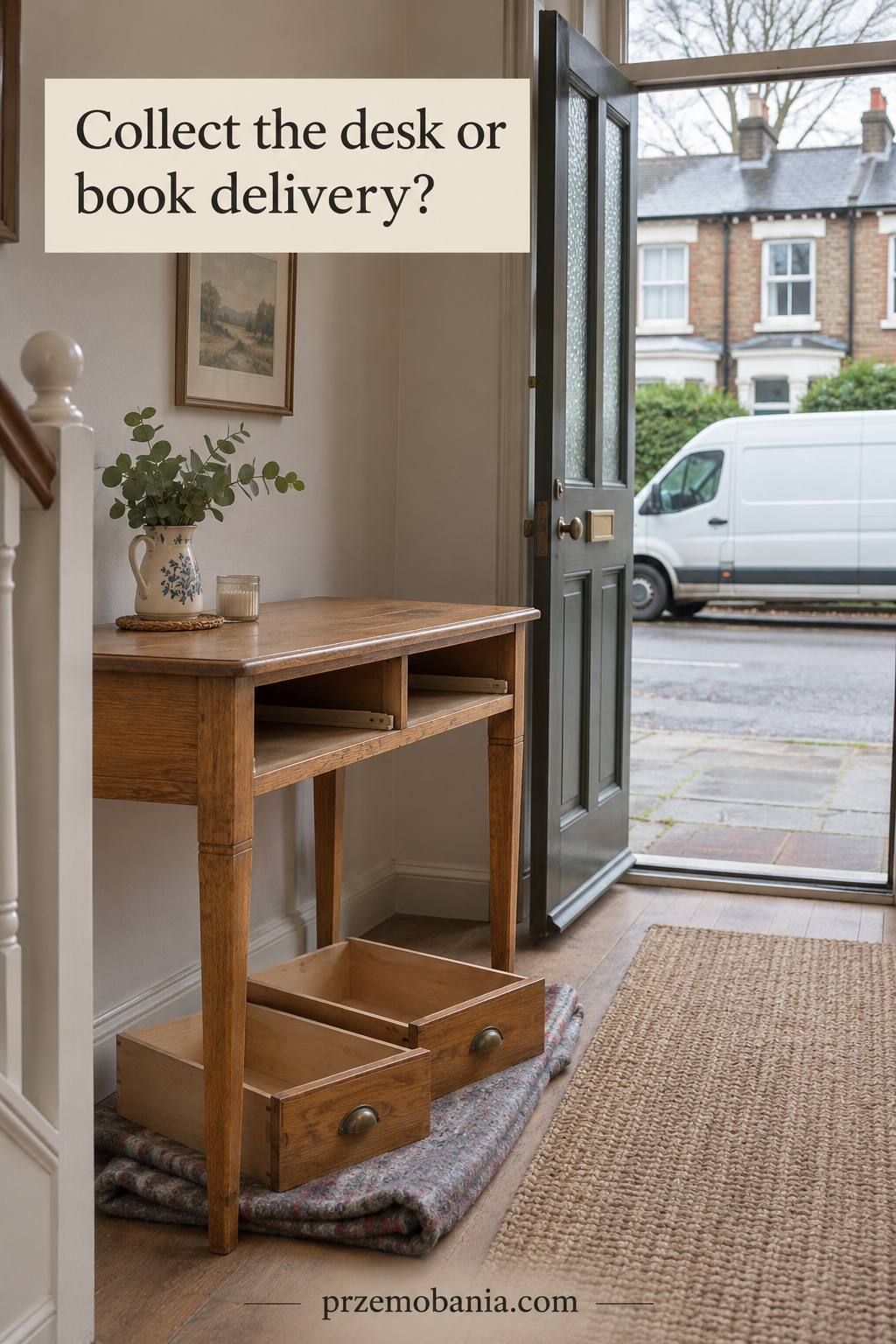
Decide what travels separately
Loose drawers, a cable tray and a bag of screws can disappear from the description even though they are essential to using the desk. Count them as separate pieces when you request the quote. If the top comes off, establish who will remove it and whether the fixings will already be labelled when the vehicle arrives.
It helps to have a photograph of the collection as it will be handed over. A drawer unit on castors can resemble part of the desk in an advertisement, although the seller intends to keep it. One picture with all the agreed pieces together settles that question for you and gives the person collecting a useful reference.
Put the self-drive option on a clock
Draw the route from your own front door back to it. A self-drive collection can involve travelling to the hire branch, collecting the van, driving to the seller, unloading at home, returning the vehicle and getting home again. The distance between the desk and your house accounts for only one of those journeys.
Put a time beside each fixed point. A seller offering collection between ten and eleven is useful only if you can collect the van early enough to reach them. Check when the vehicle must be back and whether the return arrangements fit the branch you have chosen, especially when your collection is near closing time.
Use the actual quote for the vehicle class and dates you need. Copy the hire charge, included mileage, any extra mileage rate and the stated fuel arrangement onto your comparison. Leave an empty line for anything the quote does not settle, and keep the confirmation with the branch details so you can find it on collection day.
Separate cash you spend from money you need available
If the hire company requires a refundable deposit or payment-card authorisation, record it on a separate line. It matters whether you can make that amount available on the day. Adding it to the hire price as if you expect to spend it, however, makes your comparison misleading.
Count the arrangements that exist only because you are hiring the van. That might be a bus fare to the branch, parking during unloading or the cost of extending the booking to fit the seller’s window. If a friend is simply giving you a lift, mark the lift as agreed and put their availability in the timing column.
Find out where the delivery price ends
Ask the delivery provider to name the collection point and the handover point in their reply. A vehicle and driver outside your building may meet the description “delivery” while leaving you with the problem of getting a rigid desk upstairs. A room-of-choice service may cover that part, subject to the access you describe.
Give the provider a useful picture of both entrances. Mention steps between the pavement and the front door, the floor at each end, a lift if there is one and any long walk from the nearest practical parking place. A photograph of the stair turn can communicate the shape of a landing much more clearly than a promise that it is “quite wide”.
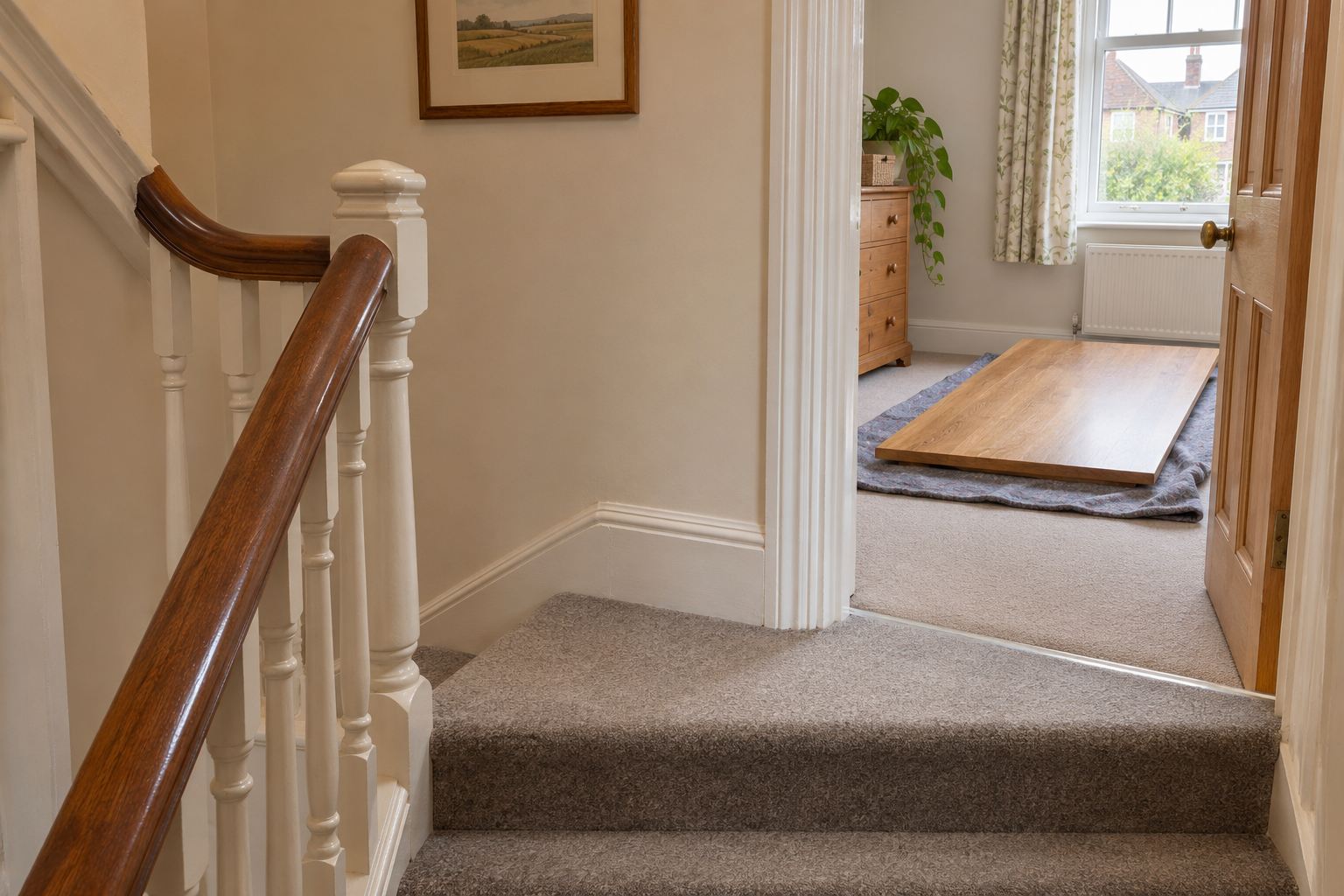
Ask how many people attend and what they have agreed to do. If you cannot help with carrying, say so before booking. If the quote assumes the desk is dismantled or wrapped, put the name of the person doing that beside the task. A written “yes” to delivery upstairs still leaves those other questions open.
Give the seller a collection window they can actually accept
A cheaper shared-load service may offer a wider arrival window than a dedicated collection. Find out when the seller receives the window, how much notice they get before arrival and who can contact the driver about a delay. Then ask the seller whether that arrangement fits their day.
For a seller who can hand over the desk only during a lunch break, the window may decide the whole comparison. There is little value in obtaining a lower price for a time they cannot accommodate. Ask for the price of a narrower window, or compare self-drive against another day when the seller can be more flexible.
Compare two written offers on the same basis
Take a sheet of paper and make two columns, one for self-drive and one for delivery. Across the top write the same start, finish and list of pieces. Beneath each option record the amount payable, the time you need to be present, who handles the furniture and every condition that has yet to be agreed.
Here is a hypothetical example using round figures purely to show the arithmetic. Imagine a van quote of £54, an estimated £12 for fuel and £6 to get back from the hire branch. Your self-drive estimate is £72. You have agreed help at the seller’s end, yet you still need somebody available when you get home.
Now imagine a delivery quote of £86. If that includes a two-person collection and placement in the study, the quoted difference is £14. The decision is whether that £14 is worth the return journey and organising help at home. If the £86 ends at the front entrance, you still need a price or an agreed plan for the last part before drawing the same conclusion.
Try changing the single assumption most likely to fail
Suppose your helper can come only at four. Ask what happens if the seller is an hour late, then look again at your branch return time. A booking that works comfortably at four but requires another hire period at five deserves a second calculation with the relevant charge from the provider.
There is no need to give every minute of your day a cash value. Sometimes “I can be home for an afternoon delivery, but cannot take the morning off to collect the van” is enough to choose. Write that constraint next to the prices so that a small saving does not conceal the reason one option suits your household better.
Send one short message before you book
For delivery, try a message like this. “Please confirm the total for collecting the desk and two loose drawers from the first floor at the seller’s end and placing them in my ground-floor study. The desk will be assembled. There is no lift at collection. Does your price include the people needed at both ends, and what would change that price?”
For self-drive, put the questions to the hire branch and the seller separately. Ask the branch to confirm the vehicle class, collection and return times, mileage terms and fuel arrangements for your booking. Ask the seller whether the agreed pieces will be ready at the stated time and who will be there when you arrive.
Keep the replies together with the listing and your measurements. On the day, that gives you a single place to check the number of pieces, the address and the handover arrangements. If the seller says the desktop now needs to come apart, update the provider before anyone sets off and ask whether the original quote still applies.
Final Word on Collecting or Delivering a Used Desk
My starting point would be the last doorway. Picture where the desktop and drawers need to be when the job is finished, then work backwards until you can name the person responsible for each handover. That exercise often reveals the one missing answer that matters more than the advertised price.
When both quotes cover the same journey, the choice becomes personal in a practical way. You can see what your money buys, which part of the day you are giving up and whether the people you are relying on have actually agreed. Save that comparison until the desk is in its room and all its pieces are accounted for.

Find Out More About Me

Przemo Bania is a blogger and writer who helps people get out of their traditional jobs to start a blogging career. Przemo also runs a health blog advocating for endometriosis and fibromyalgia…
Related Questions You May Be Asking About Used Desk Collection and Delivery
Should I include the price of the desk in both columns?
You can write it once at the top if the seller charges the same amount whichever way you collect. Compare the transport totals underneath, then add the chosen one to the purchase price. If the seller offers a different price for collection on a particular day, record that difference explicitly.
What if the seller offers to deliver for a small extra charge?
Treat the seller’s offer as a third column and use the same start and finish. Ask who will bring the desk indoors, what time they can arrive and whether the extra charge includes every piece. A short journey in the seller’s vehicle may be an excellent fit once those details are agreed.
How do I compare a fixed quote with an hourly one?
Ask the hourly provider when charging starts and stops, whether there is a minimum charge and how waiting time is counted. Work out a total for an ordinary run and a second total using a plausible delay at the more difficult address. Keep the fixed provider’s exclusions alongside those figures so you can compare the same work.
References
- Enterprise UK guide to car and van hire costs
- AnyVan’s two-person furniture delivery service and what it covers
