
Would you drive across town for a second-hand desk if the only photograph showed it with a laptop covering the middle? A tidy listing can tell you that you like the desk while leaving the most important question unanswered. Will this particular piece work in your room, in the condition it is in today?
Ask for the photograph that settles your next decision. Start with the whole desk, then request a closer view of the feature you depend on, with enough of the surrounding furniture in the frame to recognise where it belongs.
Writing about the workspace my wife and I share has made me interested in details a listing can easily miss. For someone else a shallow drawer below the top might be a selling point. For us, whether a chair can pull in underneath it matters more. My guide to the total cost of a second-hand desk covers the wider decision once you know what you would actually be collecting.
- Read the photographs already in the listing
- Ask for a wide view and a detail that belong together
- Get the measurement that affects your chair or equipment
- Look inside the one drawer you intend to use
- Use labels and joint photos to identify what is included
- Send a request the seller can answer in one visit to the desk
- Final Word on Asking for Used Desk Photos
- Related Questions You May Be Asking About Used Desk Photos
- References
Read the photographs already in the listing
Look at the desk as though you were about to sit down. Find the front edge, the space for your knees, the side where your chair would enter and the patch of desktop where your keyboard would land. A desk against a wall may conceal its back completely, but that hardly matters if yours will stand in the same position and you do not need to attach anything there.
Now write down one sentence about the uncertainty that would change your plans. “I cannot see whether the drawer unit is fixed on the left” is more useful than “I need more pictures”. If your room only accommodates the opposite arrangement, that detail can settle the decision before anyone starts measuring the top.
Look across the listing for a second angle before messaging. A shot taken from the side may already show that a dark strip under the top is a shallow drawer. Zooming into the first photograph can enlarge the same patch of shadow without adding any information about what is inside it.
Ask for a wide view and a detail that belong together
A close-up of a chipped edge is hard to interpret in isolation. A small mark at the back of a desk going against a wall has a different consequence from an identical mark where your forearm will rest. Ask for one view showing the corner in relation to the drawer or leg, followed by a closer photograph of the damage.
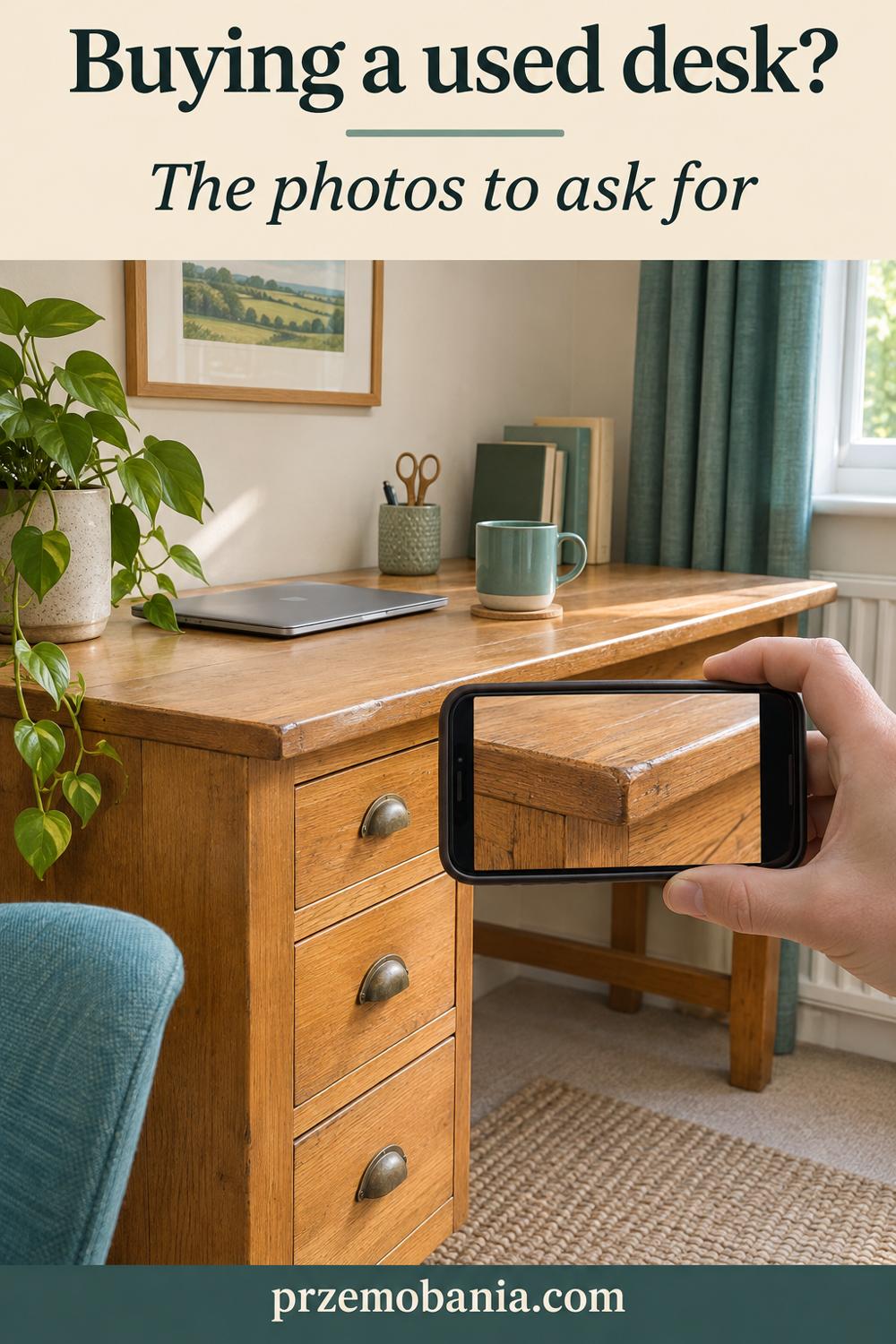
In the example above, keeping the drawer front in the frame makes the position of the scuff clear. If the seller can take only one more picture, a slightly wider photograph with the corner and drawer both visible may answer more than a tightly cropped shot of the wood grain.
Daylight from the side can help distinguish a dent from a change in colour. Ask whether the seller could photograph the same area from another angle in the room’s usual light. They can move the phone instead of moving a heavy desk. A dark line that disappears with a change of angle gives you a different question to ask at collection from a raised edge visible in both views.
When the finish matters to your work
Think about what actually touches that part of the top. A little wear behind a monitor may be perfectly acceptable. A lifted seam directly under the edge of a drawing pad could catch the paper each time you turn it. If a desk mat would cover the area, check whether it would also cover the cable opening you planned to use.
Colour is harder to settle by message. A cream wall, a warm lamp and the phone’s exposure can all affect the impression of the timber. If matching an existing cabinet is essential, treat the photograph as a reason to view the desk and make your final comparison in person.
Get the measurement that affects your chair or equipment
A seller may quite reasonably give you the desk’s overall height when you ask how tall it is. Your chair arms have to pass beneath the lowest obstruction. Ask for the distance from the floor to the underside of the drawer or rail at the point where the chair enters, and say which face of the desk you mean.
If the opening is narrower near the floor, ask about that section too. A modesty panel can stop a deep chair base going as far back as the photograph suggests. Compare the reported measurement with your chair at the height you actually use, with the arms and wheels in their normal positions.
For a monitor clamp, ask for a side view of the rear edge only if the seller can reach it easily. You want to see the top, the underside and any metal rail immediately behind the edge. Compare that arrangement with your own clamp instructions. A thin-looking top is little help if the lower pad would land on a sloping lip.
How to read a tape-measure photograph
Look for both ends of the dimension. A picture of the number alone leaves open where the seller started and whether the tape crossed the narrowest part. A plain written measurement between two named points may settle more than a blurred photograph of the entire tape.
For example, suppose your chair arms span 58 cm and the listing gives an overall desk width of 110 cm. Neither number tells you the gap between the drawer pedestal and the opposite leg. Ask for that clear opening, then mark it on your floor with two strips of paper and roll the actual chair between them. The exercise can reveal that you normally approach the desk at an angle.
Look inside the one drawer you intend to use
A closed drawer tells you about the handle and the finish. An open view can show whether the drawer has sides high enough for what you want to store, whether the bottom sits squarely and whether the opening belongs to the part of the desk you expected. Ask about the drawer you intend to use every day.
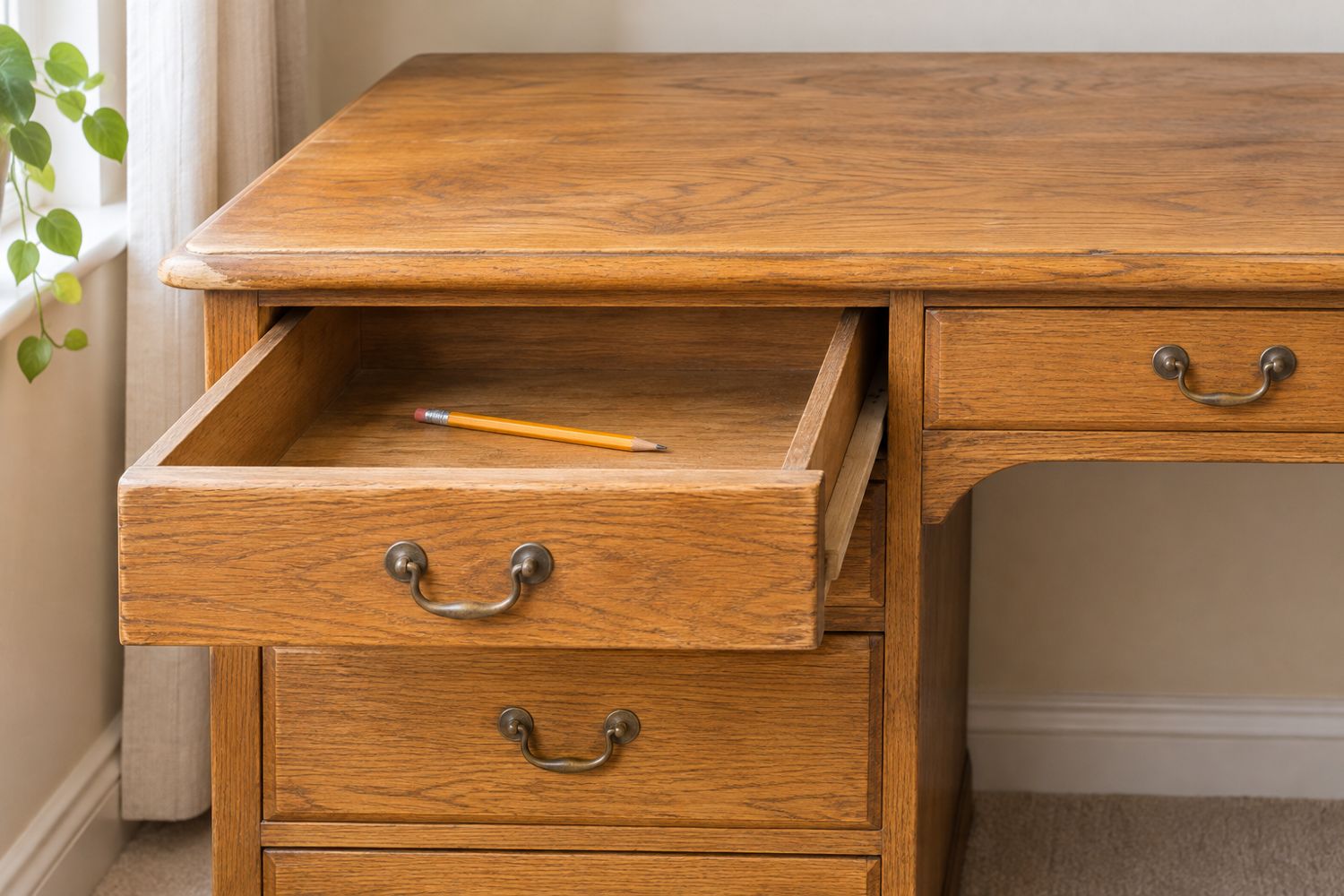
Imagine buying a desk partly to put away a laptop each evening. The wide drawer front makes that look promising, but the usable space may narrow behind it. Ask for the internal width and depth at the base, and check the height at the opening against the laptop in its sleeve. Leave yourself room to get your fingers underneath it again.
A photograph cannot tell you how a loaded drawer will travel. If the front appears lower on one side, ask whether it opens and closes normally when the desk is standing in its usual position. Keep testing the movement on your collection list. Asking the seller to yank a stiff drawer out for a better picture risks damaging something both of you would prefer to keep intact.
Use labels and joint photos to identify what is included
If the seller names a particular model, a readable photograph of the product label can save a long exchange about superficially similar desks. Ask for the furniture label only. Receipts, delivery labels, serial numbers unrelated to the model and paperwork with a home address can stay out of the frame.
Look up the model’s assembly instructions where they are available. Compare the arrangement of legs, drawers and rails in the instructions with the broad photograph of the actual desk. Two versions of a product can look alike from above while using different supports underneath. A manual is most useful once you have linked it to the particular piece on offer.
If the desk is already dismantled, ask for the parts laid out as they are stored. A wide picture can show whether both side panels are present. A separate picture of a bag of fittings can help you see which pieces to check against the parts list, although repeated silver screws in a photograph are easy to miscount. Keep an unconfirmed fitting on your list instead of guessing its size from a picture.
Send a request the seller can answer in one visit to the desk
Lead with the reason you are asking. “I’m checking whether my chair will go under the drawer” tells the seller where to point the camera. It is also easier to answer than a list covering every scratch and fitting when you have not yet decided whether the furniture is the right shape.
A first message could read, “I like the desk and I’m checking the space for my chair. Could you tell me the floor-to-drawer clearance at the front, and send a front-on photo showing the drawer and both legs? The pictures already show the desktop clearly, thank you.” Once that answer arrives, decide whether there is a genuine reason for a second request.
Suppose the reply shows that a rail runs across the front. If the chair cannot tuck away, another five close-ups of the finish will not alter the result. If the clearance works, the remaining question might be as small as whether the rubbed patch on the right feels rough. Ask that one question and save the rest for the viewing.
Final Word on Asking for Used Desk Photos
Before arranging collection, put three short notes beside the listing. Record what the pictures show, what the seller has measured and what you still need to try. “Left drawer present”, “chair opening measured between the legs” and “test the drawer movement” give you a practical starting point when you arrive.
If a detail remains hidden, decide how much that uncertainty matters to your room. An unseen back panel may be an easy compromise for a desk against a wall. Uncertain knee clearance is a different matter if both people who share the desk need to use the same chair. The right photograph answers a question about the working day you are buying the desk for.

Find Out More About Me

Przemo Bania is a blogger and writer who helps people get out of their traditional jobs to start a blogging career. Przemo also runs a health blog advocating for endometriosis and fibromyalgia…
Related Questions You May Be Asking About Used Desk Photos
What if the seller can only send one more photograph?
Choose the view most likely to change whether you make the journey. If width is the deciding factor, a front view of the opening with the measurement written in the message is useful. If you can already see the dimensions and are worried about damage, use that last photograph to locate the damaged part on the desk.
Should I ask the seller to dismantle the desk for a picture?
Start with what they can show while it is standing normally. A label, an accessible joint and the manufacturer’s instructions may answer your question without anyone removing a fitting. If dismantling is essential for transport, agree separately who will do it and how the pieces will be kept together.
Can a photo tell me whether the desk wobbles?
A still picture may show something worth asking about, such as a foot that appears to be missing. It cannot demonstrate what happens when someone types or leans on the writing surface. If stability matters to you, ask to see the desk assembled at collection and allow time to decide before it is taken apart.
How do I keep two similar listings straight?
Save each seller’s answers alongside the correct listing and note which drawer or edge the picture shows. Use a detail you can recognise, such as a brass pull or a left-hand pedestal. That small distinction keeps a useful answer about one desk from quietly becoming an assumption about the other.
References
- eBay UK guidance on photographs in listings
- IKEA UK guide to finding product assembly instructions
- IKEA UK guide to identifying small replacement fittings
