

Winter Home Office Window Treatments
Does closing your office curtain solve the evening chill but make the last hour of daylight disappear too soon? Winter home office window treatments need to balance light, privacy and the practical space around your desk. If every option seems to solve one problem while creating another, I would begin with how the window behaves during your working day.
Winter home office window treatments help manage daylight, glare, privacy and heat loss. Choose curtains or blinds around the window’s position, opening method and heating, keeping ventilation accessible and checking performance after dark rather than assuming a daytime view guarantees privacy.
My interest in interiors began with my mum, and after my wife’s chronic illness changed our routines I helped create working spaces that were easier to use, bringing that personal perspective to my blog alongside the research sources listed below.
The measurements that matter extend beyond the width of the glass. A handle, radiator, monitor or curtain stack can decide whether a covering works comfortably.
I would also test privacy when the room is illuminated, because a fabric that feels discreet during daylight may behave differently at night.
These choices form one part of my wider approach to preparing your home office for the colder months.

Choose Winter Home Office Window Treatments By Function
I would write down the main job you need the covering to do. That could be managing a screen reflection, improving evening privacy or adding a thermal layer. Try not to turn every possible benefit into an equal priority.
Winter home office window treatments work best when the daily routine is clear. Note when you open and close the existing covering. Notice which adjustments you avoid because they are awkward.
Look at the window from the chair and from the doorway. Check whether the desk obstructs the handle or controls. Consider how the covering moves when the window opens.
Then inspect the space above, beside and below the frame. A curtain needs somewhere to gather when open. A blind needs an appropriate fitting position and usable controls.
I would choose the operating method before becoming attached to a fabric. An easy adjustment is more valuable than a beautiful covering that stays in the wrong position all day. Keep a record of the measurements so comparisons remain practical.
Making a room easier for my wife to use taught me that reach and effort belong in decorating decisions. You should not have to climb around furniture just to change the light or close the view into your home.
- Identify Your Daylight And Privacy Needs
- Measure The Space Around The Frame
- Compare Curtains And Blinds Honestly
- Keep Heating And Ventilation Accessible
- Choose Controls You Can Use Easily
Identify Your Daylight And Privacy Needs
Observe the window at the times you actually use the room, including after dark if you work late. Low sun may reach the screen briefly even when the office is gloomy for much of the day. I would note the direction and timing of that problem rather than decide immediately that the whole window needs a heavy covering.
For privacy, assess the view when lights are on inside and it is dark outside. A sheer or light-filtering fabric may not provide the privacy you expect under those conditions. Use product information and a sensible real-world check rather than relying on the name of the fabric alone.
Decide which need must be solved first and which is optional. This can make a simple covering more suitable than a complicated layered arrangement. It also gives you a clear question to ask a supplier, such as whether a particular fabric will meet your evening privacy needs at that window.
Measure The Space Around The Frame
Measure according to the supplier’s instructions for the intended fitting method, because an inside-recess blind and an outside-recess covering are not ordered in the same way. I would record more than one width or drop where required rather than assume the opening is perfectly square. Check units carefully before entering an order.
Include handles, opening sections, sill depth and nearby furniture in your notes. A blind may clear the glass but catch a handle. Curtains may fit the wall but gather into the space occupied by a monitor or shelf when open.
Check what is below the window as well. A radiator changes how you should think about curtain length and placement, and loose fabric should not obstruct heating or ventilation. If the installation needs fixings, confirm that the proposed surface and method are suitable. An accurate set of measurements is only useful when it describes the way the covering will actually operate.
Compare Curtains And Blinds Honestly
Think about the trade-off each option makes rather than looking for a universal winner. Curtains can bring fabric and a softer appearance into the room, but they need space to hang and gather. Blinds can offer a more contained profile, though their controls, fitting and fabric still need careful consideration.
A thermal or insulated product should be judged by its specific information and installation requirements. Do not assume that every thick-looking fabric performs equally, or that a label promises the same saving in every home. Your window and the way you use the covering affect the result.
If you combine a blind with curtains, give each a distinct purpose. For example, one might manage daylight while the other provides the evening finish you want. I would avoid adding layers simply because a photograph includes them, especially where the extra bulk makes opening the window or reaching a control more difficult.
Keep Heating And Ventilation Accessible
A window covering should not prevent the room’s other systems from doing their job. I would check radiator clearance, ventilation openings and access to handles before settling on a final length or fitting. This is particularly useful in a small office where the desk is close to the window and several functions share the same space.
Energy Saving Trust advises closing suitable curtains at night while avoiding blockage of radiators. Keep required vents available rather than treating them as draughts to be hidden. If there is persistent condensation or a defect around the window, investigate it instead of covering the evidence with heavier fabric.
For a broader cold-room problem, my guide to finding the cause of a chilly workspace gives you a different starting point. A covering can help with a specific window-related need without being the complete answer to an uncomfortable room.
Choose Controls You Can Use Easily
Picture opening and closing the covering with the desk in normal use. If you need to move the monitor or lean over a sharp corner every time, I would revisit the arrangement. A different control position or operating method may be worth more than a decorative upgrade to the fabric.
Consider cordless or other suitable safe-by-design options, particularly where children may have access. If a product uses cords or chains, follow its installation and safety instructions and the British Blind and Shutter Association’s guidance. Do not leave a loop accessible or improvise a substitute for the specified safety device.
Motorised controls can be convenient, but check power, charging, manual operation and any dependence on an app before buying. A simple system that remains understandable is usually easier to live with. The aim is a covering you adjust willingly as conditions change, rather than one whose controls become another small frustration.

Test Winter Home Office Window Treatments In Real Conditions
Samples can help you compare appearance without committing to a whole room. I would look at them beside the wall and furniture you already own. Then check them under the lights you use in the evening.
Winter home office window treatments should also be tested for their intended function. A small swatch can show colour and texture. It cannot demonstrate every aspect of a full installed covering.
Ask the supplier clear questions about privacy and light control. Check whether the description refers to the fabric or the complete installation. Gaps at the sides can matter even when the material itself blocks light.
For curtains, consider how much of the window remains covered when they are open. For blinds, check the space occupied by the raised stack or rolled fabric. Those details affect the daylight you keep.
Keep the opening method available. You should be able to use the window as intended after installation. Check that cleaning and ordinary maintenance remain manageable.
I would also confirm the return and measurement policies before ordering. Made-to-measure purchases deserve a careful final check.
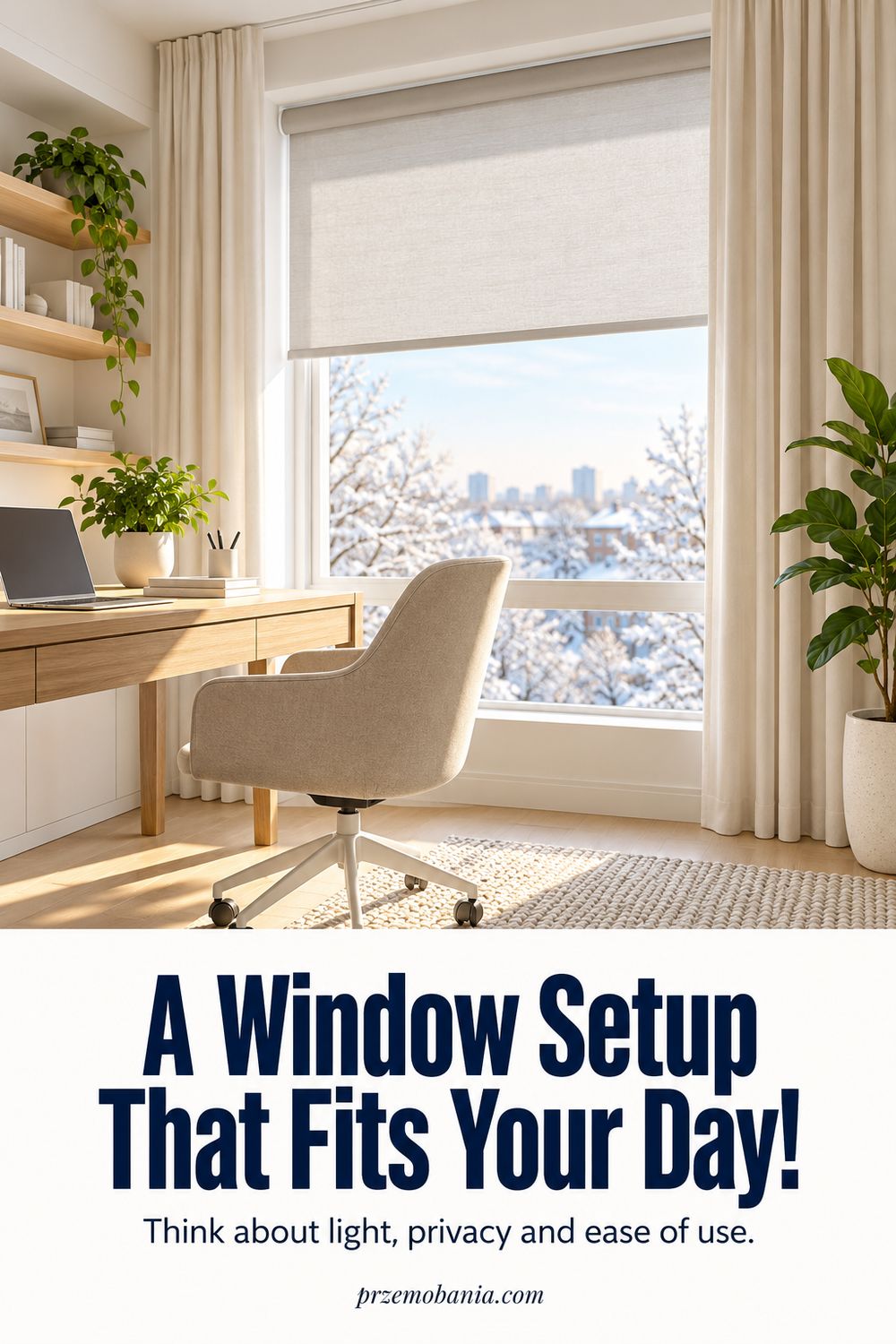
Use Winter Home Office Window Treatments Through The Day
A useful covering supports a simple routine. I would open it when daylight is helpful and adjust it when a specific problem appears. Avoid leaving it fully closed out of habit if that makes the desk harder to use.
Winter home office window treatments work alongside artificial lighting. When you close the evening covering, check whether the task light needs adjusting. My guide to lighting your desk as daylight fades covers that transition.
Keep controls clear of papers and equipment. Check cords, fittings and moving parts as part of ordinary household maintenance. Follow the product’s care instructions rather than assuming every fabric can be washed.
Review the setup after moving the desk. A covering that worked well with the previous layout may need a different daily adjustment.

Final Word on winter home office window treatments
I would choose a window covering by imagining yourself using it on an ordinary winter afternoon. You have work open, the light is changing and you need an adjustment that takes very little effort. The right solution makes that moment straightforward. It does not require you to rearrange your equipment, accept an unwanted view into the room or give up more daylight than necessary.
Winter home office window treatments sit at the meeting point of several needs, which is why a purely decorative decision can feel disappointing later. Colour and texture are visible immediately, while awkward controls or a blocked radiator may only become obvious during use. Taking time to check those less glamorous details helps the finished room feel considered in a way that lasts beyond the first photograph.
I would be cautious about universal promises. A product described as thermal, blackout or light-filtering still needs to be understood in the context of your window and installation. Ask what the claim means, check the practical limitations and avoid expecting one material to solve every problem. Clear information is more useful than a dramatic saving or comfort claim that may not apply to your home.
Your circumstances also matter. A rented flat, a shared bedroom and a dedicated study may need different solutions, even with similarly sized windows. You may prefer an easily reversible change, a very simple control or a fabric that is straightforward to care for. Those are sensible priorities, not compromises that make the room less worthy of attention.
The lesson I return to from helping my wife is that a room should be easy to adjust when your needs change. A handle you can reach and a covering you can operate comfortably may sound like small details. They become much more meaningful when you repeat the action every day, especially during a busy or difficult week.
Start with the main problem, measure the whole situation and compare options against that brief. Keep heat, ventilation and access in the picture, then choose the appearance you enjoy. You can create a window that belongs beautifully in the room while still respecting the practical job it has to do. That combination is far more useful than choosing by fabric alone and hoping everything else will work.
Begin with the window’s real job: daylight, glare control, privacy or a thermal layer. Measure the surrounding space, check heating and ventilation, and choose controls you can reach. Test the evening conditions too, so your covering works for a normal winter day rather than only looking right in daylight.
Leave a comment about the change you want to make, and check the FREE eBook at the bottom for more ideas to help your workspace fit your life.


Przemo Bania is a blogger and writer who helps people get out of their traditional jobs to start a blogging career. Przemo also runs a health blog advocating for endometriosis and fibromyalgia…
Related Questions You May Be Asking About winter home office window treatments
1. Do sheer curtains provide privacy at night?
Not necessarily. Their effect depends on the fabric, lighting and view from outside, and they may reveal more when the room is lit after dark. Check the specific product and test the conditions that matter to you. Do not assume that daytime privacy means the same arrangement will work at night.
2. Are floor-length curtains always best for winter?
No. The right length depends on the window, nearby heating, furniture and movement through the room. A long curtain may be attractive but unsuitable where it obstructs a radiator or catches behind a desk. I would choose the length that allows the whole arrangement to function, then refine the styling.
3. Is motorisation essential for an awkward window?
It is one possible option, but not the only one. Consider whether moving an obstruction or choosing another suitable operating method would help first. If you choose motorisation, check charging, controls and manual options. Convenience is valuable only if the system remains practical for the way you use the room.
winter home office window treatments References
- https://energysavingtrust.org.uk/wp-content/uploads/2022/11/Energy-Saving-Trust-Warm-Home-Hacks-guide-final.pdf
- https://www.makeitsafe.org.uk/householders-landlords/new-blinds/
- https://www.hse.gov.uk/PuBns/priced/l26.pdf
