
How do you put a letter away without forgetting the reply you are waiting for? A letter can be easy to find and still be easy to forget. Once you have posted a form or emailed a question, the paper on your desk no longer tells you whose turn it is or when to pick it up again.
Give the paper a named home and put a dated prompt somewhere you already look. If you use the home filing system for active paperwork, this is how to run its waiting folder between sending a request and receiving a usable answer.
Keep the unanswered question, its evidence and a dated follow-up prompt connected.
I like a reminder that tells you exactly what to ask when it appears. That small detail can turn an uneasy feeling that something is overdue into a call or email you can make straight away.
- Make a follow-up card while the request is fresh
- Keep the reminder small and the evidence together
- Deal with the four things you might find on review day
- Split two replies when they lead to different decisions
- Test the folder before you leave the desk
- Build a reminder you can act on during a busy week
- Decide what happens when you are away
- Final Word on Tracking Paperwork While You Wait for a Reply
Make a follow-up card while the request is fresh
Start with the last thing you actually sent. Read it as if you had just taken over the job from someone else. Could you tell what would count as an answer, where that answer should arrive and which piece of paper you would need next?
On a scrap of card, write the subject in words you would recognise in a week. Underneath, enter the date sent, the answer you need and the date you will look again. A short identifying detail, such as the supplier’s quotation number, helps when the same firm has two jobs in progress.
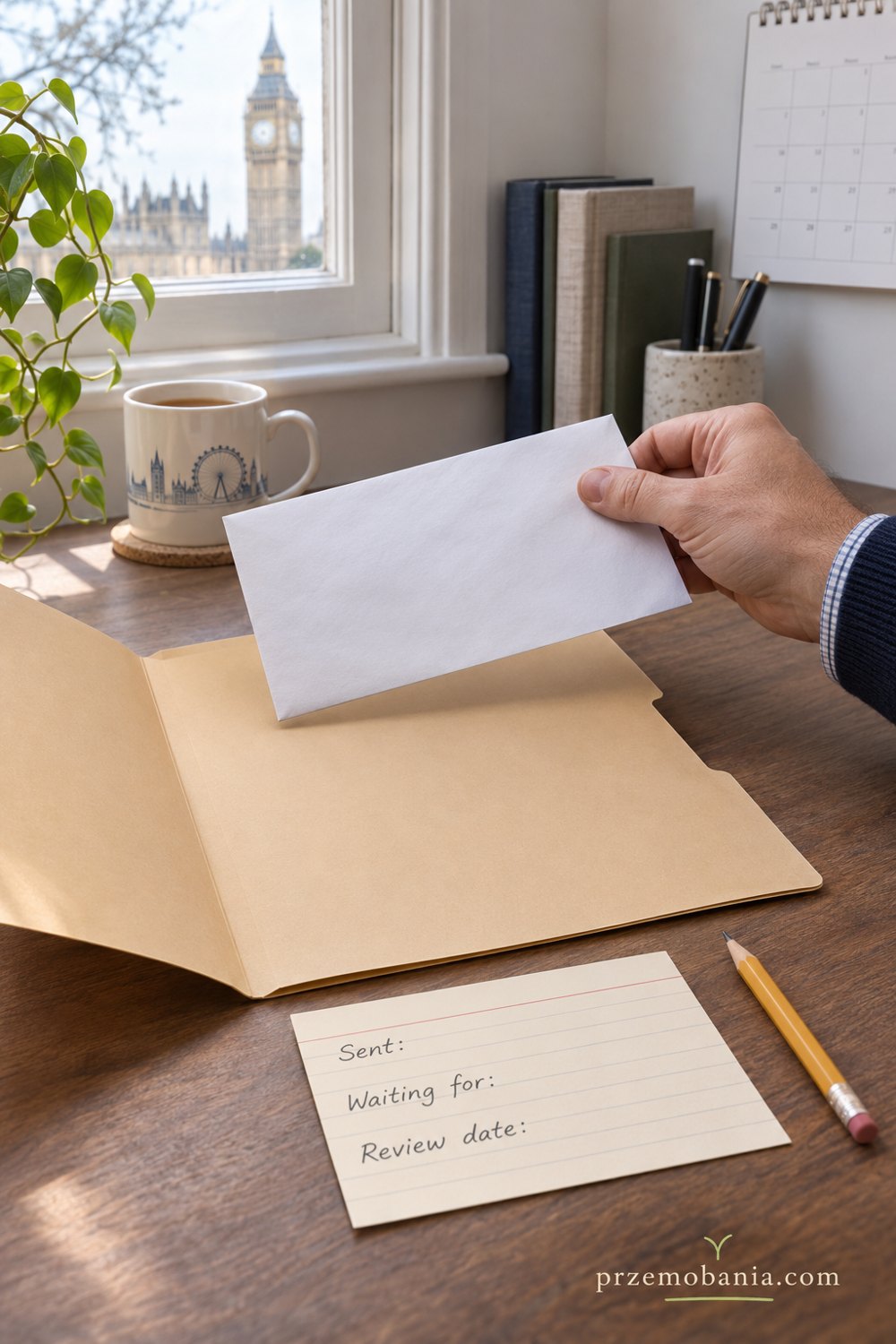
“Desk quote, revised width” makes a better heading than “Furniture”. Beneath it you could write “Sent Monday by email. Waiting for a drawing showing the cabinet on the left. Check Thursday morning.” Keep the card with your copy of the request and put a matching reminder in your diary.
Choose a date you can act on
A promised reply date, a review date and your own deadline can be three different things. Suppose a supplier expects to send a drawing on Tuesday and you want to decide on Friday. A Wednesday morning review gives you a chance to ask for the missing drawing while you still have time to use it.
If nobody has given you a timescale, choose the review date by working backwards from your next decision. A non-urgent request for a colour swatch can wait until your next planning session. A missing measurement that holds up an order deserves a reminder before you sit down to place that order.
Keep the reminder small and the evidence together
Use the diary entry to point to the paper. “Check cabinet drawing, waiting folder, tab D” works on a calendar that other people can see and avoids copying the whole correspondence into a second place. If the details are sensitive, choose a neutral reference that only makes sense alongside the folder.
Keep the paper you will need to interpret the answer. For the cabinet, that might be the marked-up sketch sent to the supplier. A full printout of every email makes the useful page harder to spot, whereas a note of the message date and subject lets you find the conversation again.
What if you have sent the only original?
Before you post an original, check the recipient’s instructions on what they require and which references they give you. In the folder, leave a note of what went out, how you sent it and where you kept any permitted copy or proof of posting. A page that says “original sent” prevents a fruitless search through the rest of the cupboard.
If the answer is due through an online account, identify the account on the card without writing down its password. A calendar prompt to check email will send you to the wrong place if the answer is waiting in a portal. When several channels are possible, begin with the one the recipient specified.
Deal with the four things you might find on review day
A complete answer
Lay the reply beside the original request and check each question against it. If the drawing shows the agreed width and the correct cabinet position, the waiting stage is finished. Put the papers with the work you can now do, and cross off the reminder before opening the next message.
An acknowledgement or a partial answer
“Thanks, we have received your drawing” confirms receipt. It still leaves the practical question open. Record the acknowledgement and keep the question visible on the front card so it cannot disappear behind a reassuring subject line.
If the supplier confirms the width but omits the left-hand cabinet, narrow the card to that one missing detail. Reply in the original thread if appropriate and quote the precise question. Replace the reminder with a fresh review date once you have sent the follow-up.
Nothing has arrived
Check the original address or destination, the sent copy and the reply channel before writing again. This small search can uncover a saved draft, a returned envelope or an answer sent under a different subject. If the request never went out, move it back to your own action pile.
A short follow-up can contain everything the recipient needs. For example, “I emailed on Monday about quotation D17. Could you confirm whether the cabinet is on the left when I sit at the desk? I’m due to review the drawing on Friday.” Note when you sent it, then choose when you will check again.
The question has become unnecessary
Perhaps the desk has been sold or the project has moved to another room. Add a closing note so you can explain why the request ended if someone replies later. Remove the diary prompt and return any papers you still need to the relevant project file.
Split two replies when they lead to different decisions
One folder can hold the evidence for more than one question. Give each question its own line if different people owe you an answer or you would act on the replies at different times. Otherwise, the first answer can make the entire folder look finished.
For a shared office refit, you might be waiting for the landlord to confirm a delivery entrance and the supplier to confirm carton dimensions. Record each name, question and review date on the same card. When the dimensions arrive, tick that line and keep the entrance question open until the landlord replies.
Test the folder before you leave the desk
Close the folder and look only at tomorrow’s diary. If a reminder comes up, can you go straight to the paper, identify the missing answer and decide whom to contact? If any of those steps relies on remembering yesterday’s conversation, add the missing detail now.
The folder has done its job when you can put the paper away and still trust yourself to return to it. Keep the sent date, the unanswered question and the next review together, and even a late reply has a clear route back into your work.
Build a reminder you can act on during a busy week
Imagine you have asked a supplier to confirm whether a replacement drawer front will match your desk. You have the order number in one email, a photograph in another and a copy of the question on the desk. If the reminder simply says “chase desk”, you still have to read all three items before you know what to ask.
Write the unanswered question in one sentence and give the evidence a single address. For example, “Has the supplier confirmed the finish and delivery date for the replacement front?” points you towards the missing information. Keep the order reference and the location of the photograph with the file. The calendar reminder can be much shorter because it now leads to a usable record.
Suppose the supplier replies with a date but says nothing about the finish. Keep the useful date and reduce the open question to the missing finish. This keeps the next message focused and avoids asking a second person to repeat information already supplied. The follow-up card should get shorter as uncertainty is resolved.
Decide what happens when you are away
Before a holiday or an unusually busy stretch, review items that will need attention before you return. For each one, ask whether the review can move, whether somebody authorised can take it on or whether a real deadline needs action now. Record the decision beside the item so moving a calendar entry does not quietly alter a commitment.
If someone else takes over, give them the narrow question and enough context to recognise a complete answer. Tell them where the approved record lives and what they may do when a reply arrives. A person able to receive a message may still need to refer a decision back to you. A clear handover prevents two enquiries going out on the same morning.
After your return, look at the evidence of what actually happened. A colleague may have spoken to the supplier by telephone while you were away. Add the date, the substance of the answer and any agreed next step. Keep the entry specific enough that you can distinguish a firm arrangement from an expectation that still needs confirmation.
Final Word on Tracking Paperwork While You Wait for a Reply
Use the waiting folder to put one clear question back in front of you at a useful time. When a reply arrives, keep what it settles, identify what remains and move the paper accordingly. A reliable reminder gives you permission to stop carrying an unfinished conversation around in your head.
What helps you remember to follow up when a reply is late? I’d love to hear in the comments. You can also read the free chapter of my cosy home office eBook.

Find Out More About Me

Przemo Bania is a blogger and writer who helps people get out of their traditional jobs to start a blogging career. Przemo also runs a health blog advocating for endometriosis and fibromyalgia…
Related Questions You May Be Asking About Tracking Paperwork While You Wait for a Reply
Should every letter have its own reminder?
Group correspondence when one answer resolves the same decision and the review date is genuinely shared. Give separate reminders to items with different owners or deadlines. The test is whether closing one entry could cause you to overlook something that still needs a response.
What if I cannot tell how long a reply should take?
Check the acknowledgement or published service information for any timeframe, then choose a sensible date to review your position. Label it as your own review date. If there is an actual application, contractual or appeal deadline, record it separately and check the relevant official instructions.
How should I record a reply received by telephone?
As soon as practical, note the date, the organisation, the point agreed and what happens next. If a significant detail is uncertain, seek confirmation through the appropriate channel. Keep the note alongside the original question so it can be understood without relying on memory.
Can I keep sensitive details off a shared family calendar?
Yes. Use a neutral reminder that points to a document stored appropriately, such as “review item in blue working file”. Make the private record detailed enough to identify the next action. This preserves the usefulness of the reminder without displaying personal or business information to everyone who sees the calendar.
Tracking Paperwork While You Wait for a Reply References
- The National Archives guidance on organising retrievable records
- ICO guidance on working from home securely
